Sunday, September 30, 2012

The Opportunity Costs of Education

Many, many years ago, quality education is considered to be a luxury; only children from rich families are able to get education. Now, education is an essential component in our lives and considered a norm to society. The importance of education cannot be denied; our modern society revolves around the qualifications and degrees earned in order for us to pursue a worthwhile career with a handsome paycheck. For this reason alone, education has now become an industry in it own; the number of learning centers and university counselors has tripled as of this year compared to only 5 years ago. The industry of education is now full of opportunities for wealthy careers, as education continues to be valued very highly to society. Each year, hundreds of thousands of students compete against each other from around the world to apply for a possible placement in a higher education facility (i.e. University) in a brutal application process, whereas it is much more easy to get into a University 20 years ago. Parents now place education and academic results as the top priority for their children.


*"Education=Future - New Equation?": Education is valued very highly in modern society, the gateway to a desirable future.

One of the reasons why Education is so valued is because it is now much more accessible to low income groups. For the average low income family, they view education for their children as a ticket out of poverty and access to better living conditions. Also, governments view education as a merit good; something that is deemed to be socially desirable and can benefit the society. However, private firms view education to be something that would not be profitable, as rational firms aim to profit-maximize. So education will be under-provided and under-consumed in society. As a result, governments have improved the access to education through direct provision or subsidize consumers and suppliers alike. For example, La Salle college in Hong Kong gives free education to many low income families. In many places, education is free with many state-run schools, and in comparison only few private schools.

So why has education propelled to the top spot in the list of priorities of parents for their children? Firstly, as we have mentioned above, the accessibility of education. Secondly, the increase in the competitiveness of students. If I and many other high school students were to become parents in the near future, what would we be concerned about most of all? Our children's future. The society is now dominated by the desire to earn money and be positioned in a good job, as money allows people to fulfill their needs and purchase economic goods. Education in the eyes of many parents translates to a higher chance of their children being able to get a good job, hence the reason why they believe that education and the opportunity to study at a world-renowned higher education institute means a good future. Thirdly, job requirements. All firms want to recruit the best possible individuals to join their company, as high quality factors of production is very important to the success of business, whether it is increase in productivity of output. With so many people now having access to education, firms have detailed job specifications and requirements, making the parents feel that their children must have good education in order to acquire essential qualifications to have access to more job opportunities.


*"The most important piece of paper of our lives": Certificates and University Degrees are now the main requirement firms want for anyone applying for a job placement. 

Lastly, the competition between parents. Parents may not like to admit it, but it is extremely relevant to this discussion. Every parent, whether they like it or not like to boast about their children's achievements, especially the mother. My real world example would be the housewives at Pacific Club. These ladies would usually play tennis in the morning, and the first discussion, other than judging other people is to talk about their children's grades, University, subject of study etc. In this instance, we can modify 'price competition' to 'education/grade/University competition', whatever to make this easier to understand. In the eyes of those housewives, whoever's 'grade competition' is higher means that they will win, and the others will lose. Nobody likes to lose; this instinctive human response as a result of competition induces the desire for the parent's to invest in their children's education to come out as victors in the 'grade competition'. Winning and losing is part of economics, which makes this point very important.

People often express that "your children are your biggest investment." I personally agree with this viewpoint, several years back in the Hong Kong news, an average parent will spend about $40 million HKD on their children until they graduate from University. And similarly to stock markets, the success of the investment is very difficult to anticipate. One moment you are earning a fortune, the next day your stock drops like an anvil, inherently like the nature macroeconomics. If we compare the students to the stocks, we can infer that that it is difficult for the parents to anticipate whether their children will be successful or not in the future.

                 
*"Turn out which way?": Child's success and future is extremely difficult to anticipate

Next, let's look at the student's response to education. Question yourself this, do you like to go to school every morning, dressed in uniform (casual for University and possibly high school seniors) sat down in a room full of other students while the teacher bombards you with knowledge? Not really, no. While the governments and society think that education is beneficial to society, to us students, education is not exactly pleasurable. As human beings, we want to do things that will maximize our benefit, for example leisure, going on a vacation, gaming, hang out with friends at Theme Parks etc. Education does not go into that list, not now, not never. How many times have you heard your friends curse the IB, SATs, teachers or anything school-related? Many times is what I had experienced, and our school produces some of the best results in the world. If we don't like education, then why do we still do it? Do students want to get into University simply for the fact that they want to study at a higher educational facility? Firstly, education has developed into a essential good for job access into many industries. Secondly, education is now a social norm and requirement. Thirdly, and this is very much related to myself, respect and recognition gained through education  It is a human instinct and desire to want to be respected by other people by being better than them in any competition, whether athletic or academic. Education is the perfect medium to accomplish this. I know this seems more psychology than economics, but economics has deep roots in psychology as it is a study of human behavior (social science). So because education is now easily accessible to everyone, it has changed from a want, to a need.

What about the University themselves? The admissions process can be one of the most frustrating and cruel stages students need to undergo through their academic careers. So how do Universities decide who are the able applicants and those who are not? We hear about the American's "holistic approach" and others think that its subjective. This is a job mainly for the students to do. If we imagine that each of us are particular firms with our own unique brand name and identity, we have to "differentiate" ourselves to get noticed, as we are competing for limited University spaces, who act as the consumer, hence this is similar to "product differentiation." Ever understand why our parents make us learn musical instruments and participate in sports? The main reason is that they want us to be different from other students so that we could effectively "sell" ourselves to the Universities. Furthermore, if we were to represent the students as a market, then the market structure would be monopolistic competition. We are heterogeneous goods since we differentiate ourselves; each of us have a "price setting" ability since we can control over how we value ourselves as products by which Universities will consider. To a large number of Universities, we are imperfect substitutes for each other, and extreme competition between every student affect the degree of differentiation. Switching roles now that we students are the consumer and the University the firm, then we are subjected to "Price Discrimination". Price Discrimination is a practice by which firms charge different prices to different consumers for identical goods and/or services. The market segments in this case are local students and international students, where international students have to pay more to 'subsidize' the local students, as international students are often wealthy. Universities are able to do this because they each have 'monopoly power', they are able to prevent the resell of the good/service since applications identify particular students, and are able to separate different market segments.


*"Masked elegance and beauty": Prestigious Universities in appearance, a plethora of economic activity going on the inside.

University rankings have indirectly taken the role of market share to a certain degree. I recently opted to do a survey of Hong Kong students. When I asked them, "which Universities do you know or have heard of?" 100% have heard or knows about the top 3 Ivy League Schools (Harvard, Princeton and Yale), 100% knows about Cambridge and Oxford. 90% of the students know the top 10 Universities in the world, but 17.6% do not know anything about the courses or anything specific about the top schools including location. Unsurprisingly, only about 5% know about the Seven Sister Colleges (Bryn Mawr, Wellsley, Mount Holyoke, Vassar, Smith, Radcliffe and Barnard), and 0% have even heard of Rensselaer Polytechnic University located in the US. To understand the extent of the problem, someone from my school, King George V School, thought that Harvard was in the UK!


     
*The Thinker: "Harvard in the UK?", John Harvard: "No! What person would think that!?" : Universities are recognized by their name first, before getting information about the institution.

To be honest, if one does not know whether Harvard was in the US or UK then that already explains the problem doesn't it? Only the best Universities get recognized; implying that its admissions officers are going to be drowned in applications. From this, we can see that there are a few Universities that dominate the market, since they have the greatest ability to attract students.

Economists always use a simple but fundamentally important process when making decisions, unlimited wants, limited resources, scarcity and opportunity costs. Opportunity cost is the value of the next best alternative foregone after an economic decision is made. Decisions regarding education have many factors to consider: the University you wish to attend, what subject you want to study, what career paths and choices do your subject give you access to, the high school course you should take, whether to focus on SATs or the school curriculum etc. Let us consider some simple examples where opportunity costs play a role in influencing the choice we make.
  • University - Cambridge or Harvard? UCL or Imperial College London? Choosing between such top Universities can be a real headache for students, considering that offers are given. Imagine the students as consumers and the Universities the firms. Assuming that the prices to attend each University are equal, this means that each University will compete against each other with non-price competition. The types of non-price competition include the name of the University (of course), their place in the rankings, the types of courses they offer, the employment figures upon graduation, the student experience, the location, the food etc. Usually, the brand name of the University and the ranking plays the largest role in the student's choice. For example, one of the teachers from my school got an offer from both the University of Michigan and Columbia University to do her masters degree in Mathematics. She preferred the rigorous course at UMichigan, but in the end opted for Columbia University because she wanted that brand name and qualification from a well-reputable Ivy League School.
  • Subject Choice - this factor very much relates to the one above. Let the student in this example be from Hong Kong. He had received offers to study Economics at the University of Cambridge and Medicine at the University of Hong Kong? If he were to choose Economics at Cambridge, then the opportunity cost would be to study Medicine in Hong Kong. The opportunity costs include: being with his parents in his home, having a sense of security in a city he has lived for all his life, paying less expensive school fees, nearing 100% employment (since HK has an insufficient supply of doctors), having a high social ranking occupation, lacking language barriers, staying with familiar friends, eating familiar food etc. On the other hand, if he were to choose HKU Medicine, then the opportunity costs include: the once-in-a-lifetime experience studying at one of the most internationally recognized Universities in the world (2012 Ranked #1: QS World University Rankings), learning to be independent, having freedom from parents, making new friends, staying in a place with a favourable timezone for Premier League and Champions League Matches, countryside experience away from the polluted city, Fish & Chips! etc. Very hard indeed, but the final decision depends on what you personally like, since everyone's desires and what benefits them are different. Moreover, different subjects have different types of opportunity costs, or advantages and disadvantages. For example, if one chooses medicine to study at University, then there is guaranteed employment, high pay if successful and higher social recognition, but it is a life long commitment to continual knowledge enrichment; it does not stop after graduating from medical school. Next, if one chooses to do Fine Arts, then it should be comparatively easy to study, but the modern society's demand for Fine Art students is considerably weak as opposed to a 100 years ago, so it is difficult to find jobs as it is not very popular in many industries.
  • Undergraduate, Masters or PhD? - The opportunity costs with these are usually related to time and the career path. Doing Masters Degree or PhD will require a lot more time, therefore the opportunity cost is finding a job and starting to earn money earlier. Another opportunity cost by studying a Masters Degree or PhD is job mobility. As we become more professional in a particular field of study, our job mobility declines, hence we become only tailored to a specific career path. Alternatively, choosing to only have an Undergraduate qualification means that you become less competitive against other students who have better qualifications, and with the population of students continuing to increase, an Undergraduate Degree may not be enough.
The best way to evaluate opportunity costs are consideration into the short term and long term gains, with long term usually being the more favourable one. For example, eating junk food everyday; you get short term pleasure through the taste, but you then experience long term build up of cholesterol and the possible arise of health problems. Similarly, you work hard and focus on studies in the short term, in the long term you do well in exams and get into a top University. Of course, the notion of success through prowess in education has elements of uncertainty.

Having brought that up in the above paragraph consider this: "Is education really worth all the money and effort?" An individual's education does not completely decide what career path he/she follows and success. For example, the most popular Japanese comedy duo, Downtown. The boke (funny man) Matsumoto Hitoshi san (松本 人志) and tsukommi (straight/rational man) Hamada Masatoshi san (浜田 雅功) both did not attend University and are high school drop outs. Yet, they are arguably the most successful and well-known comedians of their time and revolutionized manzai (traditional style of stand-up comedian in Japanese culture) forever. Additionally, there have been many people who are graduates from top Universities but have entered the television industry, for example comedians Ben Miller, Simon Bird and Joe Thomas have all studied at the University of Cambridge in Physics, English and History respectively. It may seem ridiculous to go into comedy after studying at Cambridge, but consideration of the opportunity costs may indeed favour the comedy career path.


*Pictured above: Comedy Duo Downtown's Matsumoto Hitoshi (Left) and Hamada Masatoshi (Right)

To conclude, education is a necessity in the modern society through the increase in competition between people for scarce job opportunities and money. Often viewed as something that would determine success in careers, education's importance is undeniable, but is not strictly true. Consideration of the opportunity costs, short term and long term gains, and general economic analysis, we have shown that education is not as simple as we may first think. In actual fact, it is very complex. The value of education is the highest as it has ever been, and its only going to go even higher.

Saturday, September 8, 2012

Invisible Money Part II: Artificial Consumption

If you have not read the previous article, then you can read it here. If you have read it, then just a quick summary of the Invisible money. You should know that Invisible money is an issue to all our economies in terms of using invisible assets to pay for real assets, the illusion of an equivalent exchange of goods for money. Other issues include the formation of a bubble economy and the quick deterioration of both investment and commercial banks' money supply. Now, lets examine part two of the problem.

If we refer to our original example of an individual who earns $10,000, yet is able to purchase many things of a monetary value above that of his/her income. This is attributed to the wealth of the person, who has invisible assets; this is a reason for why many people are able to purchase well above their income levels. Here is the exact problem: since our purchasing capability is so much greater than our actual income, then this must also mean that we are consuming at a level above our income level. When we purchase goods, most of the time we do not exchange real money for real goods, in reality, we exchange invisible money for real goods. Invisible vs. Real? I'm sure we know what the problem is now: We are consuming at a level that does not reflect the overall income of our economies, hence the term artificial consumption.


*"What?? I didn't buy my laptop?": Invisible money allowed us to purchase goods that we couldn't buy with real money, creating a purchase illusion.

Computers, television sets, books, a lot of what we own, that a lot of us do not realize is actually a luxury that we might not even have in the first place given our income. At first, it may seem ridiculous to think that the capital, electronic or expensive goods in general that we buy are not paid for with physical money. Each good or service is assigned a monetary value that changes with the price mechanism; the forces of demand and supply. But when we purchase notably expensive goods, then we use credit cards. Effectively, we are using future finance through borrowing money from the banks. So the banks help us pay the firm and we get to pay back in small amounts until the debt is paid back in full with interest.

The main problem with artificial consumption is that we are consuming at a much higher level than our income allows us. If we were to only use physical money to purchase goods, then this means that we may not be readily able to buy a place to live, laptops, smartphones etc. But since we are able to, that means that we are consuming at an artificially high level beyond the money available in the whole economy. If we relate this to prices we see today, since the world aggregate demand is abnormally high, wouldn't this induce demand pull inflation so that every good or service should be priced much more than it is currently? As this is not the case, then this must suggest that there is an illusion of cash flow, alluding people to think that they are wealthy, but in reality are much poorer than they believe. Also, it would be troublesome in the current social environment to suddenly increase the prices of goods as governments would like to prevent social unrest and riots that is an example of market failure; causing unwanted costs to the society. Furthermore, the social and moral dangers of invisible money means that we are using our resources at a much greater, unsustainable rate than our money supply allows us. China now purchases 40% of the world's copper supplies and that the BRIC developing countries (Brazil, Russia, India and China) will consume 3.7 million more barrels of oil a day in 2012 than they did in 2008. The main consequence? Increasing rate of Global Warming and environmental destruction.


*"Please help me!": A result of us humans demanding and consuming at an artificially high level; the rate of Global Warming is much faster than expected.

Credit is the main cause of artificial consumption. The concept of being able to borrow a vast amount of money from a creditor, then return the money little by little is majorly flawed. Not only is the bank putting themselves in danger to borrow money for perceptibly small returns given the enormous figures in an average banker's paycheck (if it is even real money at all!),  Personally, the existence of credit has its benefits of making the cash flow around the economy more efficient. But in the long term, it could well be the biggest problem that lies in the economies of the 21st century, and there is no going back...

Sunday, August 26, 2012

Invisible Money: Uncovering the truth

Ever since the introduction of the credit card and the idea of borrowing from financial institutions, people's access to money has never been so great. A credit card is a payment card issued to users as a system of payment. It allows the cardholder to pay for goods and services based on the holder's promise to pay for them. The idea of borrowing and lending money became integrated into the cash flow system of our respective economies. Economists would say that the idea of credit and debt is responsible for granting the efficiency of cash flow around the economy, ranging from cheap loans to expensive investments. If you want to open up a new business nowadays, you simply pop over to your local bank, ask for the required sum of money, sign several documents regarding the mortgage payments, and you would be on your way to set up your business. It is so easy to borrow money nowadays, almost too easy...


*"Out with the money, in with the credit cards": Credit card usage have changed the way we humans purchase goods and investments

However, I believe that credit in itself is a very faulty, and dangerous concept that has the potential to cause detrimental effects to current economies dominated by financial means. Now, before we are able to move on to the term "Invisible Money", we have to establish one concept that people often find hard to distinguish between.

Income vs Wealth

Income represents an individual's consumption and savings opportunity within a specific time frame expressed in monetary terms. In layman terms, it means the person's real assets. Wealth, on the other hand, is a measure of everything that has value owned by a country, an individual or even the individual himself is worth something. There is no universal definition of wealth, but we often find that one person's wealth is greater than that person's income. For example, how does an office worker, who earns $10,000 HKD, be able to pay for a high-quality Armani Suit and still have money to pay for rent, food, transportation, a Rolex...the list could go on and on. From this, we can see that the person's income does not reflect the value of goods he owns. However, as economists, we know that everything has a monetary value that changes through the price mechanism, so there must an invisible force of money that allows the person to expand his consumption beyond his available means, hence the term "Invisible Money". If we go back to our original concept of income vs wealth, then we can see that income represents real assets, whereas wealth includes both real and invisible assets.

Having distinguished between income and wealth, we will now move on to the problem of borrowing money from financial institutions. It is important to realize that majority of our wealth does not come from our income. Actually, much of the money we use is artificial or what I call "future finance". Future finance essentially means that an individual is using more money than his/her actual income by borrowing money. Borrowing money is already using future money, as one is using money that is not originally from his/her own source of income, and has to pay back the money little by little with interest until its returned to the creditor (bank).

The problem with future finance, in my opinion, is the quick deterioration of the bank's liquidity. The frequency of borrowing and lending will pose potential unwanted risks associated. Investment banks like JP Morgan and commercial banks like HSBC are not doing very well recently; on 13th of July, JP Morgan record losses of about $5.8 Billion USD, while HSBC is cutting thousands of jobs in the UK to cut down costs and may receive $700 million USD fine from the US government by financing terrorists and other criminal activities, and money laundering. Another, more 'cheeky' indicator for how badly banks are doing is in the amount of bonus the respective banks' CEO's are earning. If the banks are doing well, then the CEO's will receive a lot of bonus. So how much did they earn this year? No bonus. To show you what the problem is across all banks, please take a look at the diagram below:


  1. The public, who want to save money to either receive interest from the bank to his/her account or has too much money to spend (Not likely, except if the individual has a high marginal propensity to save), will choose to put their money in the bank. Hence, the money supply increases in the bank.
  2. Firms or individuals who want to invest, or purchase fixed assets or start up new retail outlets will need a large amount of financial backing to support the investments they are going to buy. In most cases, these small firms and individuals will not have saved enough money from their income in order for them to buy the investment, hence they need to ask the bank to lend them money. If the bank gives the firm or individual the green light, the money is transferred and the investment is made. *Note that the borrowed money that the bank gives to the investor is the money savings from our bank accounts!
  3. Over time, for about 20 years (this is for my family's apartment flat) or less, the firm or individual pays the bank back in fixed amounts with interest (a percentage of the borrowed money as a "commission" to the bank), which is the bank's profit. This is called a mortgage.
  4. When the people who made the bank deposits to their savings accounts decided to spend again and are short of physical money (bank notes), then they will need to withdraw their money from the bank via ATM machines. The bank has no choice but to give them their money.

The bank's return is paid over the long term, whereas the money that the bank borrows to the investors and the money that the people withdraw are immediately transferred, hence the short term. Overall, this leaves the bank with a deficit in their money supply. This lack of liquid assets poses a real danger to banks who profit from interest. It is especially to the banks to lend money to firms who do not have much security or are not as "credit worthy" compared to the large firms. Irresponsible lending leads to the huge problems of large losses; Lehman Brothers had this problem, and was bankrupt since 2007, causing many problems to the worldwide economy. The only way to fix this problem if there was an equilibrium established between the rate at which people withdraw money and the bank receiving their mortgage payments, which is extremely difficult to obtain in the free market. Imagine if all the banks were to go bankrupt, it would be a total disaster.

Of course, we don't really see it happening in everyday life; banks still remain quite positive. For example, UA finance, Promise Ltd., and other financial firms' advertisements tell us how people are happy with credit, well it is quite pathetic in my opinion.

As a Hong Kong resident, I find that there is an issue with the mortgage system, which is called, in Chinese "銀主盤". Essentially, this has got to with the ownership payments to an investment. This banking program helps to pay 70% of the money for an investment, while the owner pays 30% of it. If the owner dies, then the bank, because it owns more of the payment share, has to pay the full 100% and therefore lose money on its investment. Also, the debt will not pass on to the relatives unless stated on the official document. Now we will move on to the US. Unlike other countries, the US has a really loose banking security due to the many issues of unpaid loans over the years. HSBC found out about this and immediately closed down and left the US market in March 2009, only leaving the credit card business to continue operating. It may be to do with cultural issues from " the land of the free", too bad they actually thought it applied to banks.

The final problem is the invisible money itself. We always hear these abnormally large figures of Government debt, such as US's $1.7 trillion USD external debt, or money that the central bank borrows to countries such as the 13 billion euros the ECB austerity package to Greece. Is it possible to transfer such a large amount of money, or rather, is there even so much real money in the first place? Maybe, maybe not; we can't be so sure. The amount of money, as in physical bank notes are definitely could struggle to match the figures that are recorded to be at. Is there such a way for a country to cough up so much money with physical money alone? Even when the central banks print much money to regulate to the economy, it is nonetheless difficult. My theory is that this transfer of money is numerical, as in computers assigning a value to every bank account. For example, if we use credit cards to pay, a numerical value gets deducted from our bank account, rather than money. It would be quite a shock to most people that we don't actually have as much money that we think we do, rather our wealth is determined by a numerical value. The advantage to this is that banks can have some form of flexibility over their money supply by utilizing all of their monetary power to fund large investments while maintaining the numerical value in every individual's bank accounts. However, there are 3 main disadvantages associated with invisible money. Firstly, is that if by some chance that a computer genius is able to hack into the Bank's operating system and mess up all of the values, then it would be difficult to recover one's money. Secondly, if the bank lends money to insecure investors, and are unable to return the money, then it would lead to some people, whose money was used to finance the investment, to not be able to recover their money. Thirdly, invisible money could lead to the formation of a "bubble economy". An economic bubble can be described as the trade in products and assets at inflated prices. One of the main causes of this is liquidity; there is excessive monetary liquidity purchasing too few assets, resulting in the inflation of the good in question to an unsustainable level. Basically, there are no real assets to support borrowing and lending. The Asian financial crisis is an example of this. Printing money may have an effect, but the illusion of an increase in money and income will stimulate spending, causing immediate inflation, further causing problems.

If credit were to continue in this state, we may be seeing an increasing number of economic recessions and banking problems. When we did not have credit, using the only money to purchase goods, then we would not have had so many financial problems occurring. So to conclude, if there is more invisible money, the greater the fragility, and the danger it poses to banks and economies alike.

Thursday, August 23, 2012

Australia's strengthening economy: potential for global recovery?

If we look at any current news about economics, they would usually be focusing on China, Europe or America. The European sovereign-debt crisis news are still hot; there are many new articles regarding the worsening economic performances or even the break up of the Euro itself, famously dubbed the "Grexit". However, there weren't many people paying attention to Australia's bustling economy. Australia is the 13th largest economy in the world in 2011, with a GDP of approximately US$1.6 trillion. It is one of the most modern and developed economies in the world, as is with Europe and America. So, nothing really special is happening to its economy, or is there?


*"Not making the headlines": Australia's economy is overshadowed by many people who focus on European, American and Chinese economies

Well, to make my point, here is something to for you readers to digest; the International Monetary Fund (IMF) forecasts that Australia's economy will have the most significant growth this year, in 2012 and the subsequent year, in 2013, by 3.0% and 3.5% respectively. It would certainly be surprising to most people that with the global economy powering down, all of the countries would be affected by this, even China for that matter due to weak demand from Europe and America, China's largest trading partners. Australia is an exception to this trend in global economic performance, with growth very strong in the first quarter and a slower second quarter at 4.3% and 1.3% respectively. If there is an analogy to describe this situation, it would be a sprinter and a jogger. We will represent the economic superpowers, such as China, America and Europe, as the sprinter, while Australia as the jogger. A sprinter will run his fastest and hardest, whereas the jogger will run in a consistent speed and aims for endurance. Alas, the sprinter cannot maintain its speed for a very long time and will eventually succumb to the fatigue and stop. Meanwhile, the jogger is able to maintain his/her speed for a much longer time and possibly pass through the sprinter while he's at it. Likewise, Australia to my mind has not always been spectacular, but it has always produced a good and consistent set of year end economic figures. With America and Europe continuing to perform badly and China's trade starting to soften, Australia may just jump out of nowhere and leap to the top of economic prominence.


*Sprinter vs Jogger: Australia's consistently growing economy rewarding for long term. Source: http://addisabram.wordpress.com/tag/curiosity/

Of course, we should now analyze why Australia is doing so well even in a global recession. The first reason is that Australia is self-sufficient. It has the ability to be able to rely on itself to cater for the public with its own resources and food supply. For example, the agricultural industry makes up 12% of GDP; Australian farmers and graziers own 135,996 farms, covering 61% of Australia’s landmass. It does not need to rely on other countries heavily for financial backing. The next reason, is that the banking system in Australia is independent from other countries. Foreign banks wishing to carry on a banking business in Australia must obtain a banking authority issued by APRA under the Banking Act, either to operate as a wholesale bank through an Australian branch or to conduct business through an Australian-incorporated subsidiary. Also, its reserve assets are very sufficient. Even though its external debt is around $1.37 trillion Australian Dollars, only a fifth of the debt is from the Government (lack of indebtedness to other countries) while the rest is from national companies. It is able to preserve its money supply very responsibly, unlike America who just keeps on borrowing money. The overall effect of this is that Australia would not be greatly influenced by other countries economic performances. Another reason is Australia has a large supply of resources. Many experts have asserted that Australia's abundant supply of natural resources, such as coal,bauxite, iron-ore and opal (worlds largest producer and exporter, 95% of the opal originated from Asustralian mines), is a major factor in its growing economy. The mining industry represents around 10.8% of GDP, which infers that the recent mining boom in late July has had noticeably positive effects to its exports. The increase in exports leads to an increase in aggregate demand, translating it to economic growth. Also, natural resources are essentially commodities. The commodity market is a very stable market due to near perfectly-inelastic demand for them. The constant demand for commodities and natural resources allows Australia to generate a constant source of income, backing it up well with monetary capacity and liquid assets.


*"A gift from the Gods": Australia's mines and land are full of natural resources, envied by many countries. Pictured above: Rio Tinto Mine. Source: http://www.nytimes.com/imagepages/2007/02/26/business/27miner2.ready.html

Lastly, Australia's cities are all coastal areas. Coastal areas are usually much more wealthy because the ports are good trading areas, as can be seen from China. From the east to west, the wealth of each city gradually declines, a good indicator that coastal cities are much more wealthier. Australia's trade heavily relies on ports and container ships, hence a large trade volume, stimulating economic growth.

Of course, this all seems very good. Arguably, this economic model is a near perfect one. The RBA has said the Australia's resource-driven economy has the potential to lift the global economy out of recession. However, they may be a bit too optimistic about Australia's economy bringing up the world economy, not even China could. First of all,the natural resources is not going to suffice in the long run. Official statistics from the government shows that Australia's multibillion-dollar spending boom on resources is losing momentum unexpectedly rapidly, with several projects on hold or canceled as commodity prices fall and banks become less willing to lend. This can be associated to consumer and investor confidence dropping because of uncertainty in markets. The resource boom has led to the deflation of commodity prices as weakening demand further lessens producer profits. As a result, mining companies are now laying off workers and cutting production in the hope of getting better prices for their resources. Like the "domino effect", this would not only effect Australia, but effect other countries output, thus we will likely be seeing falling GDP figures.

Carbon intensive countries, such as Australia would likely see supply side shocks in their agricultural production due to global warming. Australia's emissions of carbon dioxide during the past 25 years have risen more than twice the world average rate. The Great Victoria desert and the Gibson desert covers around 18% of the entire Australian mainland, leaving Australia unable to grow its agricultural production capacity. The increasing frequency of droughts and the depleting ozone layer leaves further uncertainty in Australia's agricultural sector.


*"A hole in the agricultural future, literally!": The depleting ozone hole layer and CFC/CO2 emissions poses uncertainty in Australia's agricultural future

Another issue that recently came in place on July 1st, was the imposition of two new taxation systems; a mining levy and a carbon tax. These two tax systems were very controversial when it came out, partly because it does not make sense to aim the tax bills towards one of their prospering industries, but also partly because it will influence consumer confidence and spending. It makes sense that most countries with cash-strapped governments are looking at the top of the income groups for money with progressive or retroactive tax systems, but Australia is looking down under, low income groups. Because Australia is carbon intensive, we could argue that the main goal of these taxes are to benefit the society by reducing the negative externalities in the form of air pollution. But if we were to use opportunity costs to illustrate this, then it means Australia are sacrificing a large potential economic growth to raising government revenue. Another problem with carbon taxes are that it is difficult to give an exact price on it (The economic cost of emitting carbon dioxide cannot be measured accurately). It forces people to bear more of the cost of carbon than it is actually worth, including its unpriced contribution to global warming. Australia, which now emits more carbon dioxide per head, is now charging A$23 (equivalent to $24USD) per tonne of carbon dioxide, which is higher than the European Union trading scheme. So overall, not many merits to these two tax systems.

No one likes taxes, if there is one stakeholder that likes taxes, then it is the government. Benjamin Franklin once stated, "In this world, nothing can be certain, except death and taxes." This may seem to dramatize the effects of tax, but they are indeed very undesirable. For instance, income taxes discourage work, corporate taxes inhibit enterprise and creates disincentive to invest, and indirect taxes may obstruct mutually beneficial economic transactions. These taxes deprive consumers from spending, and firms from raising sales revenue, meaning the amount of tax received by the government is not as much as expected. A solution to this problem is not taxing on the mining and carbon themselves, but the "rents" that producers earn. These returns on resource exports are much greater than the minimum cost required to attract the factors of production needed to extract the resources. Since commodity prices are rising, the returns have grown favourably. Therefore, it makes sense to tax the excess in returns, as it would help the government raise revenue, without demotivating producers.

Australia is a modern, developed country with a strong monetary base. Its economy has the potential to grow very much because it has been responsible with its resource management, not exploiting and using them up at a unsustainable rate. However, we have also shown that for one economy to lift up all the other economies is not very realistic. Nevertheless, if Australia's growth to is to continue, it should expand and support its enviable supply of resources and not make any controversial moves to hinder its industries.

Saturday, August 18, 2012

Commodity Prices: The inevitable rise

In the past decade, our consumption of natural resources has gone up by so much that it is not even surprising to know that its still going up. Environmentalists predict that by 2020, we would have consumed roughly 80% of the world's natural resources. While the price of manufacturing goods have remained fairly stable, it is the commodity market that we should be looking out for. Commodities are marketable goods and services that are produced to satisfy wants and needs. More specifically, commodities are essential raw materials. The starting point of nearly everything we consume, comes from commodities. For example, coffee beans to...coffee, cotton to clothes and oil for energy.


*Commodities galore: Several examples of common commodities we humans consume to a large extent.

Consumption of commodities vary from country by their development and economic performance. For example, China purchases 40% of the world's copper supplies, and its economy is performing considerably well despite the global recession. Harry Colvin of Longview Economics calculates that the four largest developing countries (Brazil, Russia, India and China) will consume 3.7 million more barrels of oil a day in 2012 than they did in 2008. In stark contrast, it was calculated that America and debt-stricken Europe would consume 1.5 million less barrels of oil a day, and both their economies are still performing quite badly.

If we are only talking about oil, then China should be the central focus point of our discussion. China consumes more oil than anywhere else in the world, and with economic growth still their main incentive, that figure will only continue to increase. One main reason for America and Europe's decreased and China's increased oil consumption is to do with politics. With oil supplies in the oceans declining at an increasing rate, countries had to turn towards middle eastern countries for their oil, its no wonder cities like Dubai and Abu Dhabi and Qatar got rich so quickly and be able to take over football clubs and ruin the game with overpowered signings! The thing with middle eastern countries in predominantly western countries are that they are usually associated with the common stereotypes for terrorists and nuclear weapons, especially Iran. Because America and Europe are so pedantic about this, they have tightened economic sanctions against Iran with the aim of forcing it to curb its nuclear ambitions. Meanwhile, China has continued to strengthen its links with the Islamic Republic. Iran’s oil, which generates around 80% of government revenues, is increasingly flowing towards refineries in China, which is now its biggest trading partner. Iran's oil is responsible for over 10% of China's oil consumption, which is very important to them.


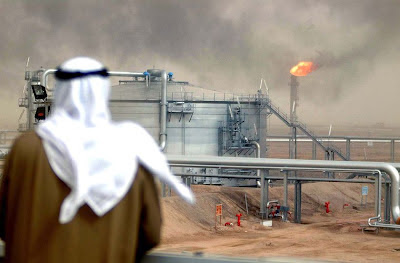
*"Digging for black gold": Countries now look towards middle east countries for oil supplies

However, in general, why have commodity prices kept increasing? There are several notable factors. The first factor, inevitably is population growth. The concept is very simple; with more people, the more resources we need to consume to meet the needs of everyone. Population is one of the largest factors for the increase in commodity prices not only qualitatively, but also quantitatively. Our current world population is 7.06 billion, and it is continually increasing by the second, with our net population growth predicted in the region of 60 million this year. Our next factor is economic development. Economic development should not be confused with economic growth. While economic growth means the increase in a country's total output, economic development takes many different factors into account, for example: increasing the people's freedom, improving standard of living and reducing poverty, providing the public with education and health care etc. The list goes on to until we reach the end of what we humans desire, of course which is unlimited wants. When economic development goes forward, we cannot go backwards, or rather we do not want it to go backwards, very much like technology.  Once again, the concept is easy to grasp: once we live in better conditions for a long period of time, we do not want to go back to living in worse conditions. So if we use more natural resources to meet our needs, then we will continue to sustain that level of consumption of those resources. Then once economic development increases once more, we will use more resources again; the overall effect is demand pull inflation. Because economic development and economic growth are very much directly correlated, we can link them together. As a country experiences economic growth, it will induce inflation. The next factor is the consumers' price elasticity of demand towards commodities. Price elasticity of demand is the measure of the responsiveness of quantity demanded to the change in price. Because commodities are essential goods that we use for majority of the things we consume, our price elasticity of demand would be extremely close to perfectly inelastic. So if the prices increase in an attempt to curb our consumption, tough luck. Our demand may not even fall, in fact it could still increase since commodities are what they are, there are none if few substitutes. Also, the commodity industries are usually monopolized by large firms, or even ran by a collusive oligopoly (cartel) such as OPEC (Organization of Petrol Exporting Countries). Monopolies are characterized as price-setters, as they have nearly full control of the market. When they realize that our price elasticity of demand is so inelastic, they will make more profit by charging higher prices. Often, governments would have set price ceilings on commodities.

The last factor is undoubtedly the main one; global warming. The main factor of global warming is human development of course. Cars, air-conditioning, washing machines, hot water showers, all you can name. All of these have increased our energy consumption and carbon dioxide emissions. So how does this effect commodities? Well, we should realize that majority of commodities are agricultural products such as vegetables and wheat, and these require optimal growing conditions to give the greatest yield. Global warming can affect the yield in two ways: directly and indirectly. Directly is through temperature increase itself; the droughts and more extreme climates negatively affect the yield of crops. Indirect means is through the changing climate. The rising sea levels will increase the chances of flooding low-lying areas, warmer seas increase the chances of typhoons and hurricanes, and droughts and dry climate increase the chances of forest fires which destroys crops and desertification swallowing up grasslands. Supply side shocks have damaging effects to the supply of commodities, which causes cost push inflation. The persistent strength of commodity prices helps to explain why headline inflation rates have been stubbornly high in many countries, despite their struggling economies. With wages weak, the result has been a squeeze in real incomes.


*"The world is burning up": Global Warming is the biggest crisis that is befalling our world in the present. Can we stop it??"

But hold on a minute, the implication of the analysis mentioned above is that commodity prices should continue to increase. However, it turns out that commodity prices have been falling sharply in July following from May—the S&P GSCI index dropped by 13% in May alone, the biggest monthly decline in two years. The average price of a gallon of petrol in America has fallen to $3.47 from almost $3.88 in early April. There are a two viable reasons for the uniform decrease. First, is that commodities have become investment-class. This would be the better reason as the price decrease may simply reflect the whims of speculators, who have little confidence in the market's future. The other worse reason is that the decrease in commodity prices may well be an indicator for the economic recession. Why? Well, if economic growth is very little or even shrinking, then the demand for commodities will contract, causing deflation. Of course, this is not a very reliable measure because prices were still very strong in the summer of 2008, after the Lehman Brothers bankruptcy. Actually, even China is not doing that well after it had cancelled a whole load of raw material import orders in spring. Those cancellations can be explained by strategic bargaining tactics rather than slumping demand, since China's oil and copper imports are still going strong with a 12% increase throughout the year. Also, weather forecasts have also predicted mild weather is leading to the expectation of bumper harvests in the northern hemisphere, agricultural product prices fell by 9.3% in May.

Commodity booms usually dissipate after the storm of high prices bring forth new supplies. People may be affected by the illusion that the fall in commodity prices may imply that we are using fewer resources. Actually some of it may be true, with many countries now putting in place new measures for sustainable development, technology to make our products more environmentally friendly and global projects to counteract global warming (E.g. GreenPeace org.). Of course, this is only considering the ideal case. Unfortunately, the ideal case may not necessarily work. All the factors that lead to inflation of commodity prices aforementioned besides the consumer will occur for a long time. And, it is going to take even longer before we are able to make our world a sustainable place to live in, since commodities have already became a fundamental part of our lives.

Our consumption of commodities can only go up. With the ruthless presence of global warming continuing to inch closer towards us at an increasing pace, we will only continue to consume more. So the final verdict: commodity prices will continue to go up. Unless we find a way to veer our way towards a new path of sustainable energy and resources, commodities may change from being a necessity to a luxury.

Tuesday, August 14, 2012

Is China beginning to get exhausted? Will America bounce back?

China's growth has been simply astonishing. Turning several decades back, China was not given much attention to its economic growth. It is only after when China overtook Japan as the second biggest economy behind America in February 2011, when people started to realize the might of their growing economy. China itself accounts for 10.6% of the world's total exports, and is continually increasing; its no wonder that the majority of things we buy are made in China. China is the largest exporter and the second largest importer in the world.

However, this week, official data published by the Chinese government indicates worrying news to the future of China's growth; its exports and imports have slowed for the second consecutive month. As a result, this year, China's economic growth has dropped to 7.6%, which fails to meet its annual target of 8%. A major effect of the slow in economic growth is due to the sharp decrease in exports. Exports are a component of aggregate demand, a decrease in exports will lead to a decrease in aggregate demand. Exports play a very large factor in China's economic growth, the lack of export "umph" could mean trouble for China's future economic growth. Although it may not be such a big problem in the short run, it could spell trouble in the long run when China simply cannot cope with the rising costs of its factors of production, thus the contraction of the secondary manufacturing sector, further denting China's export figures.

So what are the suspects of China's sluggish export figures? Well, for starters, and one of the main factors is the weakness in overseas economies. America and debt-ravaged Europe are key trading partners to China, but they themselves are experiencing big economic problems. America and Europe's weak economies are largely due to the lack of consumer spending while they are in their downward spiral recession. The business model illustrates that in a recession, unemployment increases and income level decreases, so there is a lack of demand for imports from China. Even though the lesser developed India, China's biggest trading partner is still doing well, but it alone cannot prop up China's loss in exports. The second factor is the appreciation of the Chinese Yuan. Because America is still the world's no.1 economy and one of China's main trading partners, China wants to maintain a good relationship with America. Due to China's low value currency proving a thorn in America's competitive international trade and balance of payments deficit, America has constantly pestered China about re-valuating their currency. In order to maintain a good relationship with America, China eventually gave up to the political pressures from not only America , but other countries as well and appreciated the Yuan. The appreciation of the Yuan increased the price of exports, so other countries wouldn't be able to afford as much goods from China, hence the fall in exported goods. And lets not forget, the downside to this is that Chinese tourists (who have literally taken over Tsim Sha Tsui for all I can think of), are able to take advantage of Hong Kong's pegged currency with America, stimulating demand and creating inflation.


*The Mainland invasion: Mainland Chinese people queuing outside Louis Vuitton, Canton Road, Tsim Sha Tsui.

This brings us on to the next factor, inflation. Inflation is defined as the continuous and sustained increase in the general price level. Economic growth is desirable in every economy, especially China, because it is one of the macroeconomic objectives the government wants to achieve when he is in the office. Economic growth brings about more jobs (lower unemployment), increase in income, increase in the economy's output, and high levels of inflation. Actually hyperinflation in this case. Inflation causes domestic prices to rise, which reduces domestic supply, therefore causing an increase in production costs. Next, the increase in production costs means that exports are more expensive, reducing foreign demand, ultimately reducing exports. There are two types of inflation: demand pull inflation and cost push inflation. As both of their names suggest, demand pull inflation is inflation due to the rise in demand and cost push inflation is inflation due to the rise in production costs. Demand pull inflation is because the Chinese people became extremely wealthy due to the economic growth, hence they will be more willing and able to purchase goods and services. Aggregate demand increases and and the output of the economy increases. Meanwhile, cost push inflation is due to the increase in wages of labour and supply-side shocks. For example, wage inflation rose by 20% in 2011 of factory workers, and food prices rose by 18.2% on average due to snowstorms and in the long run, the desertification. The Gobi Desert, located in Northwestern China, has been increasing at an alarming rate over the past few years; currently, 3600km sq. of grassland are overtaken every year, affecting the agricultural industry heavily. If demand pull and cost push inflation were not to occur simultaneously, that would not be too problematic, however, it is becoming a huge problem in China. It would appear if China's secondary sector is starting to deteriorate. Of course, as a country becomes more developed and people become more wealthy, the supply of factory workers will decline rapidly as more people desire higher pay jobs in offices. The reality, is that China may be heading towards the tertiary sector. Although it represents that China is heading towards economic stabilization and permanently establishing its place as a first-world country, after some analysis, it is hard to see China thrive as a tertiary sector economy.


Firstly, China's poor education system in poor areas. Although Asians, especially Chinese people, are heavily stereotyped as extremely smart (which is statistically true, Asians on average outperform other children on the SATs), poor education is ravaging the poorer areas of China. As the Chinese secondary manufacturing sector is deteriorating, the education is going to limit the jobs available to them. Linking to the previous point, income inequality. When China was still poor, the first place the government developed was the coastal cities before the inland cities. As we can see from the graph, the east of China are full of coastal cities, meaning that there are many ports. Ports are very good for trading because majority of exported goods travel on container carriers across the world, therefore wealthy cities. As we approach China's western countries, the income gaps start to widen. If anyone has every visited Wuhan or Xi'an, the area is very poor compared to the tall skyscrapers and highways in Shanghai. Since education is poor in the western cities, the lack of jobs available to them will further widen the income gap. And thirdly, technology problems. By an international standard, China's technology is not extremely developed yet unlike America or Europe. It really says a lot when we find that China's exports are mainly manufactured goods, textiles and electronic equipment and imports are mainly machinery and high-tech equipment from Japan and America. As China delves deeper into the tertiary sector, technology will be the main growth factor rather than manufacturing. But with the relatively poor education in western China, technological development will be slow, hence slow economic growth.

With the slowing growth of China's economy, we can answer another question: "Will America bounce back from their dire economic situation?" Its a question that has been pondering the minds of many economists; unfortunately, not many are very optimistic. Why? Well, their debt currently stands at $1.6 Trillion USD, with $1169.6 billion USD borrowed from China, who owns approximately 20.8% of all foreign-owned US Treasury securities. Also, their continually disappointing balance of payments deficit is further enhancing the problem, with slow growth in the second quarter this year. Hopefully, with China's sluggish export figures expected this financial year, things may look up for US made goods.

Unfortunately, the problem is not so simple as to be fixed by market-based solutions. Basically, trade alone cannot save America, because of two reasons. First, actually, America does not even spend that much on Chinese exported goods. In fact, "Made in China" only accounts for less than 3% of American personal expenditure! This may seem awkward since America is one of China's biggest trade partners, but it is true. Lets take a look at the chart below.


If this is the case, then this reflects that 67 percent of spending is on services rather than goods, and services are 96 percent made in America. Also, a lot of the spending on imported goods actually reflects the cost of shipping around America. For example, whereas goods labeled “Made in China” make up 2.7% of U.S. consumer spending, only 1.2% actually reflects the cost of the imported goods. In other words, the U.S. content of “Made in China” is about 55%. This substantial point allows us to confirm that inflation in China is not likely to have a substantial effect on the price level in the United States nor do their trade balance any good. America keeps complaining about the Yuan valued too low for the past several years, well, it seems that the Chinese officials were correct in pointing out its insignificance to America's problem.

Finally, the depletion of America's money supply. The depletion of its money supply means that the quantity of loanable funds in the economy is minimal, that means investors would not be able to borrow money and invest. As investment is part of aggregate demand, a decrease in investment leads to a decrease in the output of the economy, further worsening America's condition. As a counter solution to their debt, America has been printing a LOT of money in order to increase their money supply, hoping to create incentives to investors and increase the output of the economy and pay their creditors. Also, the printed money is sold to other economies in order to depreciate their currency, hoping to regain their competitive edge against China in terms of lower prices.


*Rolling out the money: The role of excessively printing the American Dollar is to stimulate its economy from the recession.

Although in theory, printing money has the ability to bring about beneficial changes, America's weak monetary base is significantly reducing the effect. The sudden short term increase in the money supply is only good for short term investments, and it is American's that are purchasing their own investments, hence the income flow is extremely bad. Investment and consumption is largely down to the consumer confidence, with confidence at an all time low in the current economic environment, it seems printing money may not be the best solution after all. Also, printing money will induce inflation, because the amount of money in the economy increases, so people have higher disposable incomes. Since the interest rate is not so low, people will rather spend money than save, creating consumption and high levels of inflation. And finally, the government is not able to use the printed money to pay bonds because it is not actually real money.

Short term investments take us back to the cause of the Asian financial crisis. Back in the 1990's, when Asian economies are still developing, American investors invest in their land and begin fast growing development. Exports made up a large percentage of the Asian countries' income. After they made a lot of money and America recovered from a recession in the early 1990's, majority of the investors left the Asian market simultaneously since the U.S. became a more attractive investment destination relative to Southeast Asia, which had been attracting hot money flows through high short-term interest rates, and raised the value of the U.S. dollar. Ultimately, the Asian market collapsed and caused a financial contagion. In 2007, American's also did the same, but this time, they did it to themselves. The Lehman Brother's bankruptcy sprang from exactly the same problem. America should face the cruel reality; short term increases in money supply are weak market-based solutions, it requires interventionist policies to fix the issue.

From the above assumptions, we can conclusively deduce that China's economic growth is getting exhausted is a mix of internal and external factors, with the internal factors making up majority of the problem. China's economic growth is also starting to stagnate with the weak demand from foreign countries, and may eventually turn into a tertiary sector economy. Furthermore, it does not seem America is getting back on track for awhile, since they "screwed" themselves up big-time, and there is nowhere to hide.

Thursday, August 9, 2012

Can big sporting events save European economies?

2012, the year where many people will be looking forward to. Many big events happened or may happen this year; the sudden death of singer Whitney Houston,  the newly elected chief executive of Hong Kong Leung Chun Ying founded to have illegal building structures in his home, the 2012 World Expo held in South Korea, the Geneva particle research team CERN finally finding the long sought-after Higgs Boson, Man City pipping Man United to the premier league title and the continued curse of Aaron Ramsey (read more about it at the end), and maybe the END OF THE WORLD!!
*Physicist's delight: Higgs Boson finally discovered at CERN particle accelerator. Source: The Journal.ie

So what about Europe? Well...things weren't looking peachy at the beginning of the year as the pain from the sovereign debt crisis are still lingering in many of its largest economies. Switching to present day, the UK are doing as badly as ever, Spain's 4th largest investment bank, Bankia, has recently requested a 19 billion euro bail out from the state, Italy are leaning over its book account like their famous tower of Pisa and Greece....I'm not even going near there. Who is doing well? Germany; the only pillar of hope in Europe's miserable single currency system. But that is not saying much, the European Commission Spring forecasts that the Eurozone economy will contract by an average of 0.3% GDP, and the European Union will experience zero growth in 2012.

Even though Europe is doing very badly from an economists' point-of-view, Europe can be happy about one thing, it held the Euro 2012 and London held the summer Olympics. The Euro 2012, jointly hosted by Sweden and Ukraine, was a very big event on the footballing calendar, especially to football fans around the world. What makes this year's tournament especially interesting is that there were so many things to expect: will Spain retain their crown or will Netherlands take revenge from their bitter defeat in the 2010 world cup? Can retirement-bound legendary striker, Andriy Shevchenko, inspire Sweden to Euro glory? The results? Spain thrashed Italy 4-0 in the final, and Netherlands finished bottom place in the 'group of death'. Moreover, the 2012 Olympics held in London is another long-anticipated event. China continue to establish its dominance in the sporting world by currently leading USA and South Korea in number of points and medals. Andy Murray emphatically beat Roger Federer 6-1 6-2 6-4 in straight sets to be the first UK person to claim gold since Josiah Ritchie in 1908.

Spain Wins Euro 2012 Football Championship 1 Spain Wins Euro 2012 Football Championship
*The best national team ever? Spain retain Euro crown and marked their 3rd consecutive big tournament championship win. Source: On Secret Hunt

As the date drew nearer to these two long-awaited sproting events, this begs a question. Since Europe's economy is doing so badly, can big sporting events such as these save their economies? What we imply is whether the hype of big sporting events can help to stimulate the economy. Certainly, it does not seem likely after hearing that Europe will experience zero growth rate throughout 2012, but forecasts are forecasts, and they might not necessarily be correct. Why? Because economics is not always correct; most of the time predictions are wrong.

First, lets take a look at the possible advantages from big sporting events. Many preparations are needed prior to the event, hence sporting events will increase employment. In the business cycle, the decrease in unemployment is one of the characteristics of economic growth (rise in GDP), which is obviously good to further prevent the GDP from shrinking to the point of no return. Derived from employment, the government would be able to spend less of its funds on unemployment benefits, ultimately creating available funds and overturn the budget deficit. The other advantage is that large sporting events will attract tourists to the country. With many big things to expect in the Olympics, such as Usain Bolt trying to win the 200m event tonight, many people would attend to experience the live atmosphere, even though its gonna end in just over 19 seconds. Tourism involves the export of services from that economy to the other economy using the service. Exports are an injection into the economy, so the income in the economy increases and may lead to economic growth. It is also a component of  aggregate demand, so if the country's exports increase, ceteris parabis (all other things being equal), then aggregate demand would increase.

In theory, big sporting events would be very helpful, but there are many issues with it alone to bring the economy up from its slump. Firstly, the creation of the internet. Whenever you want to find information on anything such as product reviews and what foods are low in calories, a quick search on Google will take you to your answer in no time at all. Our access to information is so much greater nowadays that we can know what happened world wide just by sitting on your desk chair, in front of the computer. If we apply this to results in the Olympics, what need is there for foreigners to travel there by plane, purchase overly-expensive tickets only to watch it live in in such a noisy environment when we could watch it at home? Of course, many people express that watching live is a totally different experience compared to watching from the TV screen, but we can now watch live streams of just about anything! So will it attract many tourists? Probably ones near the host country, but not significantly high from countries far away. Which brings me on to the next problem, the host country will have to build or improve sport infrastructures, which are funded by the state. For the amount of money being invested on organizing the event, the country will really need to expect that the event is going to be a success. Also, only the host country is receiving income from the event, other eurozone countries are not going to benefit even though it is within Europe. Lastly, and most importantly, these events are only very short term. The Fifa World Cup, Euro 2012 and Olympics are held once every 4 years, and the host will change every time. The people working in the Olympics or Euro 2012 would only be employed for only the duration of the event; afterwards they will once again be unemployed unless they find another job. Effects? The state will have to once again resume paying high unemployment benefits, possibly leading to budget deficit and a halt in growth. Likewise, although the event has the capability to generate income into the economy, it being short term creates what's called a growth illusion. Short term growth is not what will be needed to solve the euro crisis, long term growth is what we need. To do this, the respective euro countries will have to find a large and continuous source of revenue through interventionist and market-based policies, and not from the European Central Bank (ECB).

If what we are looking for are long term growth, why not try looking at football leagues rather than short term events? Europe arguably has one of the most impressive set of football leagues in the game; top-flight leagues such as the Premier League in UK, La Liga in Spain, Serie A in Italy, Ligue 1 in France, Bundesliga in Germany and the Primeira Liga in Portugal, attract a host of talents from around the world. Football is not only the world's most popular sport, but its also one off the most expensive too. An average football ticket for a match at the Emirates stadium (Arsenal F.C.) will cost you 100 pounds. Excective seats at the Santiago Bernabéu (Real Madrid C.F.) overlooking the El Classico match, will cost you 1 million euros! Its not just to football tickets, player wages and value have also sky-rocketed in recent years; the world record transfer fee of 80 million pounds for C.Ronaldo from Man United to Real Madrid marks the beginning of the new era of football, when the financial power of big clubs really started to flex their muscles. Who do you suppose caused this? When oil producers started to take ownership of football clubs. They start to pay players unreasonably high wages and clubs transfer fees for their player. For example, Paris-Saint-German spent over 150 million pounds on 4 players this summer. In 2011, Manchester City has reportedly spent 1.2 billion pounds since their takeover of the club, with 360 million pounds spent on players alone! These eye-watering figures are due to the amount of money oil producers make. The world's reliance on fossil fuels have reached a new high this year, and its only going to continue to increase as our demand keeps rising. Hence, the reason why they are making an absolute killing. If we use football in terms of representing wealth, Europe would be doing very well.

So now many of you will be asking, "what has this got to do with economics?" Everything basically. You see, there are certain conditions the state must consider before implementing policies. In the case of generating funds through football, Europe have the best clubs in the world; a perfect starting point. Next, we need to find the money...its also available in the banks of rich club owners. Furthermore, we need to have a football association that deal with matters such these...Uefa, Fifa, FFF etc. Even the Uefa President, Michel Platini, has voiced his concern of wealthy clubs ruining the game by financial incentives, and will implemented the financial fair play rule in 2013. We have met all 3 criterion. So now, what the government can do is to use selective taxation on rich football players and clubs. The advantages associated with this are quite promising. Firstly, the amount of money that can be generated from football leagues are simply astonishing, hopefully raising significant funds for the respective economies to pay debtors, and lift the euro out of recession in the long run. Secondly, the financial incentives associated to football will diminish over time, leading to fall in the player market and wage levels, hence making income distribution more even. Francis Hollande, France's prime minister, has already taken action, by slapping a 75% income tax on Zlatan Ibrahimovic's 13 million euro annual salary. The next step will be to target to wealthy owners for tax revenue. Thirdly, it will also lead to the dilution of monopoly power in the rich clubs, leading to more competitive football not dominated by big clubs winning the league every year. Lastly, it is a long term solution to raise funds, which is perfect in Europe's current economic situation.

There are, however, 2 disadvantages with this plan. It will lead to player unrest; protests to the football association would be inevitable. And, the possible decrease in the quality of football. "People respond to incentives", more specifically, financial incentives. If there is a lack of income in becoming a footballer, less people would want a career as a footballer and will look for other jobs, causing a decrease in the quality of football players, and ultimately the game itself, which may have detrimental effects the European economies in the very long run. Hopefully, Europe would have recovered by the time this happens and have tighter control of its economies to prevent another recession.

As we have stated in the previous post, in theory this would happen, but it is uncertain due to the problem of the human factor in social science. Hopefully, things will turn out like it would without the disadvantages. So our conclusion is that big sporting events are too short term to significantly impact European economies, but maybe the key lies in long term sports to prevent to collapse of the single currency.


Extra Material: The Curse of Aaron Ramsey
Aaron Ramsey is a player in Arsenal Football club that plays in midfield position. Once tipped as one of the leading talents alongside Jack Wilshere that will lift the club out of its trophy-less half decade, his fate took a rather interesting turn for the worse after suffered a broken leg after a nasty challenge by Stoke City defender, Ryan Shawcross after a heated encounter at the Britannia stadium.

He turned from one of Arsenal's brightest prospects to being booed by his own fans. Things aren't looking particularly well for Mr Ramsey; there are rumors going on that when he scores goals, a person mysteriously dies. Not convinced? Take a look:
  1. May 1st 2011: Ramsey scores winner vs Man United. Next day, Osama Bin Laden dies
  2. October 2nd 2011: Ramsey scores in London Derby vs Tottenham. Three day later, Steve Jobs dies
  3. October 19th 2011: Ramsey scores injury-time goal in CL group stages vs Olympique de Marseille. Next day, Muanmmar Gaddafi dies
  4. February 11th 2012: Ramsey scores in League game vs Sunderland. That night, Whitney Houston dies
  5. August 4th 2012: Ramsay scores penalty in quarter-final clash vs South Korea. Next day, Columbus Crew footballer Kirk Urso dies of unknown reason in first autopsy scan.
Well, whatever the reason, if we let Mr Ramsey score, another famous person has a high chance of not seeing another day.