Sunday, January 5, 2020
Market Mogul articles available on TN Economics blog
Hi all! Sorry for the inactivity on the page. Unfortunately, The Market Mogul has officially rebranded into Mogul News, and have deleted all content on the previous website, including the articles I have published before. Thankfully, we will be posting them onto the blog, and hopefully new content again on the website! Thank you for everything and happy reading!

Monday, January 21, 2019
A Shares and H Shares – Why Can The Same Company's Shares Have Different Prices? [Published March 2018]
Not all stock markets are created equal. Every country’s stock market has its own distinct set of listing requirements, trading rules, securities governing entity, the degree of technological advancement and composition of investor types (retail and institutional) to name a few.
For instance, less developed stock exchanges may have lower listing requirements relative to a more developed market to attract domestic businesses to list at home rather than abroad as well as foreign capital.
Companies can choose to list at home, abroad or both depending on the management’s view on the best course of action. In the years post-financial crisis, the NASDAQ has won several big IPOs from domestic and foreign technology firms such as Facebook (2012), Alibaba (2014) and more recently Snap (2017) because it offered Weighted Voting Rights (WVR) for founders that want to have greater control over the company they built from the ground up, influencing its long-term goals and direction.
This was the primary reason why Alibaba refused to list on the Hong Kong Exchange since they did not offer WVRs, sticking to an outdated “one share, one vote” system.
These differences account for the different valuations and market sentiment toward the country’s market. But what about the price of shares of a company? In theory, the stock price of a company that is listed on different exchanges should be equal after converting into common currency because the share price performance is based on the group’s consolidated financial statements from its operations globally. If so, the share price reflects all publicly available information regardless of which exchange the stock is listed on. In this case, there should be no need to distinguish between fundamental or technical trading.
This theory somewhat holds true to some extent. The share prices of the same company are roughly similar after accounting for exchange rates. Small differences exist but are treated as negligible. Furthermore, they exhibit very similar patterns and movements at varying levels of volatility. One example is Rio Tinto, the Australian-British metals and mining company. It is listed on both the London Stock Exchange and the New York stock exchange as the same entity. After converting into common currency based on the end-of-day exchange rate, there is a small difference of 1 to 2 dollars, but these small differences may be attributed to the imperfect markets.
Where the theory does not apply well is when one looks at the share price of companies in the Hong Kong and Mainland China stock exchanges. Chinese companies often choose to list in Hong Kong as opposed to the Mainland because Hong Kong’s stock exchange market is more developed, has a large foreign investor population, offers a better legal environment and functions as close to a laissez-faire economy as anywhere in the world.
For the Chinese companies listed in both Hong Kong and either Shanghai or Shenzhen, investors classify those shares as H-shares and A-shares respectively. The number of H-share companies is equal to 248 (Main Board = 224, Growth Enterprise Market = 24), and thus there is an equivalent number of A-shares.
Below is a graph of the Hang Seng AH Premium index which tracks the average price difference of A-shares over H-shares for the largest and most liquid Chinese companies:

(Source: FT)
If there was no price difference between A-shares and H-shares, then the index would be at 100. Over the last five years, particularly in between 2012 and the end of 2014, the index has fluctuated between 90 to 115. Although there was volatility, the index alternating between premium and discount suggests these price differences are mostly systematic.
Over the past three years, however, the AH premium index has consistently been above 100, currently hovering around 120 which indicates A-shares are at a 20% premium to H-shares. Interestingly, the AH premium jumped 30 points after the introduction of the Shanghai-HK (“SH-HK”) stock connect program in late 2014. The Shenzhen-HK (“SZ-HK”) stock connect, launched in late 2016, has had almost no effect.
The Stock Connect programs should have narrowed the premium or discount because it allowed foreign investors to buy A-shares and other Mainland-listed stocks through the Hong Kong exchange, so investors do not have to purchase H-shares just to gain exposure to that company. If there were any price differences, investors may identify that as an arbitrage opportunity and swiftly eliminate the price difference.
There have been several studies that aim to understand this phenomenon. One study by Tingting Wu and Xiaoying Gao titled “Factors of Price Difference between A-Shares and H-Shares under SH-HK Stock Connect“, identified four important factors:
Asymmetric Information – There are two sides to this argument. On the one hand, Mainland companies register and operate in China, where certain factors such as geography, culture, and differences in regulation may affect H-Share investors from accessing information. On the other hand, the H-Shares market may contain more information due to closing behind the A-Shares market. For an A-H dual-listed company for = 1, 2, … , the combined total market capitalization expressed in renminbi is used as a proxy for asymmetric information. It is predicted that a larger combined total market capitalization would reduce asymmetric information and therefore narrow the AH price difference.
The study runs a panel data regression model to test the above factors’ relationship with and significance against the A-H price ratio. The results confirm all but the differential risk preference hypothesis; This makes sense because the Stock Connect programs have diversified the investor pool investing in A-Shares, whom bring their experience from overseas markets to China and extending the investment time horizon.
The paper concludes with straightforward policy recommendations, for example, making A-Share investors more educated, speeding up financial innovation to establish effective arbitrage mechanisms, and launch the SZ-HK Stock Connect (already in place by the time of writing).
When will the price difference be eliminated? It is difficult to envision when this may happen, but it will be highly dependent on initiatives to further reduce capital flow frictions, improve information systems for transparency, and open more investment channels to Mainland investors for a more level playing field. Because no two stock markets are equal, their respective market properties can affect stock valuation.
Although China’s economy has become more open from its past communist regime, it is nowhere near to the economic freedom enjoyed in Hong Kong. The government’s helping hand has turned China into an economic superpower. To continue reaping the benefits of globalization, it should strive to make itself the global choice for equity investors.
For instance, less developed stock exchanges may have lower listing requirements relative to a more developed market to attract domestic businesses to list at home rather than abroad as well as foreign capital.
Companies can choose to list at home, abroad or both depending on the management’s view on the best course of action. In the years post-financial crisis, the NASDAQ has won several big IPOs from domestic and foreign technology firms such as Facebook (2012), Alibaba (2014) and more recently Snap (2017) because it offered Weighted Voting Rights (WVR) for founders that want to have greater control over the company they built from the ground up, influencing its long-term goals and direction.
This was the primary reason why Alibaba refused to list on the Hong Kong Exchange since they did not offer WVRs, sticking to an outdated “one share, one vote” system.
Theory of Same Stock Price Equality
These differences account for the different valuations and market sentiment toward the country’s market. But what about the price of shares of a company? In theory, the stock price of a company that is listed on different exchanges should be equal after converting into common currency because the share price performance is based on the group’s consolidated financial statements from its operations globally. If so, the share price reflects all publicly available information regardless of which exchange the stock is listed on. In this case, there should be no need to distinguish between fundamental or technical trading.
This theory somewhat holds true to some extent. The share prices of the same company are roughly similar after accounting for exchange rates. Small differences exist but are treated as negligible. Furthermore, they exhibit very similar patterns and movements at varying levels of volatility. One example is Rio Tinto, the Australian-British metals and mining company. It is listed on both the London Stock Exchange and the New York stock exchange as the same entity. After converting into common currency based on the end-of-day exchange rate, there is a small difference of 1 to 2 dollars, but these small differences may be attributed to the imperfect markets.
AH Share Premium
Where the theory does not apply well is when one looks at the share price of companies in the Hong Kong and Mainland China stock exchanges. Chinese companies often choose to list in Hong Kong as opposed to the Mainland because Hong Kong’s stock exchange market is more developed, has a large foreign investor population, offers a better legal environment and functions as close to a laissez-faire economy as anywhere in the world.
For the Chinese companies listed in both Hong Kong and either Shanghai or Shenzhen, investors classify those shares as H-shares and A-shares respectively. The number of H-share companies is equal to 248 (Main Board = 224, Growth Enterprise Market = 24), and thus there is an equivalent number of A-shares.
Below is a graph of the Hang Seng AH Premium index which tracks the average price difference of A-shares over H-shares for the largest and most liquid Chinese companies:
(Source: FT)
If there was no price difference between A-shares and H-shares, then the index would be at 100. Over the last five years, particularly in between 2012 and the end of 2014, the index has fluctuated between 90 to 115. Although there was volatility, the index alternating between premium and discount suggests these price differences are mostly systematic.
Over the past three years, however, the AH premium index has consistently been above 100, currently hovering around 120 which indicates A-shares are at a 20% premium to H-shares. Interestingly, the AH premium jumped 30 points after the introduction of the Shanghai-HK (“SH-HK”) stock connect program in late 2014. The Shenzhen-HK (“SZ-HK”) stock connect, launched in late 2016, has had almost no effect.
The Stock Connect programs should have narrowed the premium or discount because it allowed foreign investors to buy A-shares and other Mainland-listed stocks through the Hong Kong exchange, so investors do not have to purchase H-shares just to gain exposure to that company. If there were any price differences, investors may identify that as an arbitrage opportunity and swiftly eliminate the price difference.
Factors from Empirical Studies
There have been several studies that aim to understand this phenomenon. One study by Tingting Wu and Xiaoying Gao titled “Factors of Price Difference between A-Shares and H-Shares under SH-HK Stock Connect“, identified four important factors:
Asymmetric Information – There are two sides to this argument. On the one hand, Mainland companies register and operate in China, where certain factors such as geography, culture, and differences in regulation may affect H-Share investors from accessing information. On the other hand, the H-Shares market may contain more information due to closing behind the A-Shares market. For an A-H dual-listed company for = 1, 2, … , the combined total market capitalization expressed in renminbi is used as a proxy for asymmetric information. It is predicted that a larger combined total market capitalization would reduce asymmetric information and therefore narrow the AH price difference.
- Liquidity – The A-Share market is assumed to have greater liquidity than the H-Share market because of the large retail investor population in China and A-Shares being the first choice of equity investments due to narrow investment channels. The turnover of H-Shares over A-Shares is used as the proxy for liquidity. It is predicted that an increase in liquidity of H-Shares would reduce the AH premium.
- Differential Demand Elasticity – Hong Kong investors have many investment channels, but A-Shares are almost the only choice for Mainland investors. Furthermore, while Hong Kong and overseas investors can trade Mainland-listed securities without restrictions, Mainland investors can only trade if their accounts hold an aggregate balance of RMB 500,000 in cash and/or securities. Not many people can satisfy this criterion, so it creates a situation where they can only invest in A-Shares. The proportion of H-Shares in total outstanding shares is used to express elasticity of demand; greater elasticity is expected to reduce the AH premium.
- Differential Risk Preference – The paper distinguishes A-Share and H-Share investors by their investment-horizon; A-Share investors focus on short-term profits from speculation, and H-Share investors focus on long-term returns and dividends. It is a reasonable explanation for the inherent volatility in Mainland markets, remember the 2015 Shanghai stock market crash, anyone?
The study runs a panel data regression model to test the above factors’ relationship with and significance against the A-H price ratio. The results confirm all but the differential risk preference hypothesis; This makes sense because the Stock Connect programs have diversified the investor pool investing in A-Shares, whom bring their experience from overseas markets to China and extending the investment time horizon.
The paper concludes with straightforward policy recommendations, for example, making A-Share investors more educated, speeding up financial innovation to establish effective arbitrage mechanisms, and launch the SZ-HK Stock Connect (already in place by the time of writing).
Fundamental Differences
When will the price difference be eliminated? It is difficult to envision when this may happen, but it will be highly dependent on initiatives to further reduce capital flow frictions, improve information systems for transparency, and open more investment channels to Mainland investors for a more level playing field. Because no two stock markets are equal, their respective market properties can affect stock valuation.
Although China’s economy has become more open from its past communist regime, it is nowhere near to the economic freedom enjoyed in Hong Kong. The government’s helping hand has turned China into an economic superpower. To continue reaping the benefits of globalization, it should strive to make itself the global choice for equity investors.
Thursday, January 17, 2019
Hong Kong Stock Exchange's Path to Modernization
Hong Kong has established itself as one of the top IPO venues in the world. According to the World Federation of Exchanges, the Hong Kong Stock Exchange ranked no.1 five times in the last 8 years (2009, 2010, 2011, 2015 and 2016). This is due to its simple tax system, established professional services industries, common law system and proximity to the mainland.
In the last five years, improving market integration with and giving foreign investors access to mainland companies have been Hong Kong’s core strategy. In 2012 and 2014, equity trading links to the mainland were set up through the stock connect programs to Shanghai and Shenzhen respectively. On July 3 this year, the China-Hong Kong Bond Connect program began, giving offshore investors another way to access the mainland’s $10trn market.
More recently on June 27, more than $6.1bn was wiped out from the Small-Cap stocks after the “Enigma Network” report from former HKEX board member and activist investor David Webb riled the Hong Kong market; 17 companies had lost more than 40% of their value, among them was China Jicheng and Greater China Professional Services both of whom sank more than 90%.
These recent market routs have investors and policymakers questioning the integrity of the market, whether there are more problematic companies waiting to be uncovered by the next short seller, and whether this may discourage prospective companies from listing in Hong Kong.
Shrinking Significance?
The growing influence and competency of the mainland has everyone contemplating whether they should eventually stop relying on Hong Kong’s platform to connect with international investors. In 1997, Hong Kong accounted for 16% of China’s total GDP, this number is only 3% today.
Another problem with Hong Kong’s market is its industry composition. The HKEX Main Boardis rooted in the ‘old’ economy that although has served the economy well, is extremely susceptible to external shocks and cyclical movements in the economy. Financial, and Property and Construction companies make up 44% of the Hong Kong stock exchanges’ total market capitalization, whereas only 10.2% is from IT companies as of the end of 2016.
While IT’s share of the market has increased from 3.76% in 2012 to its current level (14.3% YOY increase), it is still underrepresented compared to other major financial centres. For example, the market capitalization weighting and composition for the New York Stock Exchange (NYSE) is more balanced. Financial and Real Estate account for 35.9%, while Information Technology accounts for 33% of the S&P 500’s total market capitalization.
To address these problems, the Hong Kong Exchanges and Clearing (HKEX) issued two new concept papers last month. The first paper outlines plans to overhaul the current Growth Enterprise Market board (GEM) listing requirements, and second paper details a proposal of the “New Board” to attract “New Economy” companies.
However, the current rules which allow these small, loosely regulated companies to list on GEM have created an environment where such problematic companies flourish. The NYSE, for example, says that companies trading at less than $1 per share (penny stocks) will face delisting after 30 consecutive days. HKEX has no such rules in place.
When 40% of the roughly 2000 common stocks traded is less than HK$1 per share, accounting for 4% of the total market capitalization of the exchange, it highlights the structural flaws created by GEM. New listings on GEM are only required to offer a minimum 25% of total shares to a minimum of 100 shareholders.
Since senior management is likely to keep the lion’s share for themselves, this creates a low liquidity, high volatility environment resulting from a high concentration of public shares in few shareholders. The potential big moves have attracted the attention of short sellers to descend on GEM-listed companies. In the recent stock rout, 7 of the 20 biggest decliners were listed on the GEM. The top three decliners were GEM companies: Luen Wong Group (-89%), Greater China Professional (-94%) and China Jicheng Holdings Ltd. (-95%).
Both the Main Board and GEM require that the company must be profitable to be considered for listing. Many of the “New Economy” sectors are unable to reach profitability due to factors including aggressive growth strategy and upfront research and development (R&D) costs. For example, biotech and healthcare tech companies have extremely high R&D costs, and would likely not be profitable until the product becomes commercially viable. HKEX seeks to address this missing market with the New board.
New board PRO companies need to have HK$200m minimum market capitalization and are only open to professional investors but do not require prior financial track record. Meanwhile, New Board PREMIUM companies need to have equivalent listing requirements as Main Board companies (minimum HK$500m market cap and public float of HK$125m) but are open to both retail and professional investors.
Furthermore, the New Boards would for the first time allow a weighted voting rights (WVR) structure which could make a listing in Hong Kong more attractive because it gives greater voting rights to founders, thus protect their vision for the company.
HKEX have explored the inclusion of WVR structures for SMEs in the GEM exchange back in 2014, after losing out on Alibaba’s IPO to NYSE because the HKEX refused to allow senior executives to nominate its board. However, the proposal was ultimately put on hold after mixed responses from over 200 respondents which consisted of large corporations, government and independent organisations. On the one hand, the ones who voted against WVR state that the structure violates the ‘one share, one vote’ principle of the HKEX.
On the other hand, the ones who voted for WVRs believed that it is applicable in certain circumstances, and the simplistic ‘one share, one vote’ principle can lead to short-termism in the absence of a controlling shareholder. No matter which side of the argument is correct, it is undeniable that Hong Kong’s loss is New York’s win. Alibaba went on to record the biggest ever IPO, raising over $25bn. Other developed markets have a similar, more flexible system in place for high tech, intangible asset-heavy companies.
For example, Snap Inc. has never made positive operating cash flow or profit, but still,manages to list on NYSE and was valued at US$25bn in this year’s hottest tech IPO. Co-Founders Evan Spiegel and Bobby Murphy hold a combined 88.5% of the voting power as a result of the triple-class WVR structure, giving them uncontested decision-making authority.
If HKEX does not take steps to keep up or go beyond the competition, they could get left behind in the modern financial system. The revisions to GEM could mitigate the issues resulting from the small public float, while the New Board can attract local “New Economy” sectors to consider Hong Kong over New York. Whether these changes will be effective or not, it is a step in the right direction.
In the last five years, improving market integration with and giving foreign investors access to mainland companies have been Hong Kong’s core strategy. In 2012 and 2014, equity trading links to the mainland were set up through the stock connect programs to Shanghai and Shenzhen respectively. On July 3 this year, the China-Hong Kong Bond Connect program began, giving offshore investors another way to access the mainland’s $10trn market.
Not All Rosy
However, Hong Kong has every right to be worried about its future importance to the Asian financial markets. The Hong Kong stock exchange has seen some wild erroneous moves this year. Huishan Dairy Holdings declined 85% on March 24 after becoming a target of activist short seller Carson Block from Muddy Waters.More recently on June 27, more than $6.1bn was wiped out from the Small-Cap stocks after the “Enigma Network” report from former HKEX board member and activist investor David Webb riled the Hong Kong market; 17 companies had lost more than 40% of their value, among them was China Jicheng and Greater China Professional Services both of whom sank more than 90%.
These recent market routs have investors and policymakers questioning the integrity of the market, whether there are more problematic companies waiting to be uncovered by the next short seller, and whether this may discourage prospective companies from listing in Hong Kong.
Shrinking Significance?
The growing influence and competency of the mainland has everyone contemplating whether they should eventually stop relying on Hong Kong’s platform to connect with international investors. In 1997, Hong Kong accounted for 16% of China’s total GDP, this number is only 3% today.
Another problem with Hong Kong’s market is its industry composition. The HKEX Main Boardis rooted in the ‘old’ economy that although has served the economy well, is extremely susceptible to external shocks and cyclical movements in the economy. Financial, and Property and Construction companies make up 44% of the Hong Kong stock exchanges’ total market capitalization, whereas only 10.2% is from IT companies as of the end of 2016.
While IT’s share of the market has increased from 3.76% in 2012 to its current level (14.3% YOY increase), it is still underrepresented compared to other major financial centres. For example, the market capitalization weighting and composition for the New York Stock Exchange (NYSE) is more balanced. Financial and Real Estate account for 35.9%, while Information Technology accounts for 33% of the S&P 500’s total market capitalization.
To address these problems, the Hong Kong Exchanges and Clearing (HKEX) issued two new concept papers last month. The first paper outlines plans to overhaul the current Growth Enterprise Market board (GEM) listing requirements, and second paper details a proposal of the “New Board” to attract “New Economy” companies.
Rough GEMs
GEM, first established in November 1999, originally addresses an issue that HK attracts too few SMEs, or ‘growth’ enterprises to list. It would allow companies ineligible to list on the Main Board to use the GEM as a “stepping stone” to the Main Board (streamline transfer process took effect on 1 July 2008). The higher listing requirements of the Main Board would originally have prevented these companies with potential from access to equity capital market financing.However, the current rules which allow these small, loosely regulated companies to list on GEM have created an environment where such problematic companies flourish. The NYSE, for example, says that companies trading at less than $1 per share (penny stocks) will face delisting after 30 consecutive days. HKEX has no such rules in place.
When 40% of the roughly 2000 common stocks traded is less than HK$1 per share, accounting for 4% of the total market capitalization of the exchange, it highlights the structural flaws created by GEM. New listings on GEM are only required to offer a minimum 25% of total shares to a minimum of 100 shareholders.
Since senior management is likely to keep the lion’s share for themselves, this creates a low liquidity, high volatility environment resulting from a high concentration of public shares in few shareholders. The potential big moves have attracted the attention of short sellers to descend on GEM-listed companies. In the recent stock rout, 7 of the 20 biggest decliners were listed on the GEM. The top three decliners were GEM companies: Luen Wong Group (-89%), Greater China Professional (-94%) and China Jicheng Holdings Ltd. (-95%).
Five Key Changes
The aforementioned first paper proposes to increase the listing requirements for GEM to tackle issues of low liquidity/high volatility and quality of listings. Some of the proposed changes include:- Increasing the minimum cash flow requirement from at least HK$20m to at least HK$30m: Greater cash flows indicate more operational stability to pay off short-term obligations
- Increasing the minimum market capitalization requirement from HK$100m to HK$150m: Higher market cap requirement reduces the number of potentially “bad” companies looking to obtain equity financing, increasing protection for public shareholders. Also, the higher market cap possibly represents greater confidence in the company
- Changing the post-IPO lock-up requirement on controlling shareholders from one year to two years: Longer lock-up period requirement would prevent controlling shareholders from trading on insider information, therefore increasing market confidence in the company
- Increasing the minimum public float value of issuing company securities from HK$30m to HK$45m: Greater public float value can increase market efficiency. However, it is necessary to increase the percentage share of public float (currently at 25%) to reduce share concentration
Addressing the New Economy
Another initiative proposed by HKEX is a new exchange platform for underrepresented “New Economy” sectors. The “New Economy” encompasses generally high-tech venture industries such as Biotech, Health Care Technology, Internet & Direct Marketing retail, Internet Software, IT Services, Software, Technology Hardware, Storage & Peripherals.Both the Main Board and GEM require that the company must be profitable to be considered for listing. Many of the “New Economy” sectors are unable to reach profitability due to factors including aggressive growth strategy and upfront research and development (R&D) costs. For example, biotech and healthcare tech companies have extremely high R&D costs, and would likely not be profitable until the product becomes commercially viable. HKEX seeks to address this missing market with the New board.
New board PRO companies need to have HK$200m minimum market capitalization and are only open to professional investors but do not require prior financial track record. Meanwhile, New Board PREMIUM companies need to have equivalent listing requirements as Main Board companies (minimum HK$500m market cap and public float of HK$125m) but are open to both retail and professional investors.
Furthermore, the New Boards would for the first time allow a weighted voting rights (WVR) structure which could make a listing in Hong Kong more attractive because it gives greater voting rights to founders, thus protect their vision for the company.
HKEX have explored the inclusion of WVR structures for SMEs in the GEM exchange back in 2014, after losing out on Alibaba’s IPO to NYSE because the HKEX refused to allow senior executives to nominate its board. However, the proposal was ultimately put on hold after mixed responses from over 200 respondents which consisted of large corporations, government and independent organisations. On the one hand, the ones who voted against WVR state that the structure violates the ‘one share, one vote’ principle of the HKEX.
On the other hand, the ones who voted for WVRs believed that it is applicable in certain circumstances, and the simplistic ‘one share, one vote’ principle can lead to short-termism in the absence of a controlling shareholder. No matter which side of the argument is correct, it is undeniable that Hong Kong’s loss is New York’s win. Alibaba went on to record the biggest ever IPO, raising over $25bn. Other developed markets have a similar, more flexible system in place for high tech, intangible asset-heavy companies.
For example, Snap Inc. has never made positive operating cash flow or profit, but still,manages to list on NYSE and was valued at US$25bn in this year’s hottest tech IPO. Co-Founders Evan Spiegel and Bobby Murphy hold a combined 88.5% of the voting power as a result of the triple-class WVR structure, giving them uncontested decision-making authority.
Keep up With the Competition
Major exchanges are developing innovative solutions to attract IPOs from foreign companies. Singapore stock exchange is actively considering the listing of companies with WVR structures, while the London Stock Exchange is considering an “international segment” on which large international companies with WVR structures can list.If HKEX does not take steps to keep up or go beyond the competition, they could get left behind in the modern financial system. The revisions to GEM could mitigate the issues resulting from the small public float, while the New Board can attract local “New Economy” sectors to consider Hong Kong over New York. Whether these changes will be effective or not, it is a step in the right direction.
Monday, January 7, 2019
Are Activist Investor's Market Manipulators? [Published on June 2017]
On March 24th, during a seemingly normal Friday in the Hong Kong stock market, chaos broke when Huishan Dairy’s share price plunged 85%, wiping out about $4.1bn in market value before the company stepped in to halt trading. There was no warning nor was there an immediate explanation for the sudden crash of one of the most stable stocks traded in Hong Kong.
However, in December last year, activist short seller Muddy Water published a two-part 60-page report announcing they were taking a short position in Huishan Dairy, accusing them of alleged numerous operating and accounting frauds and confidently stated their trademark phrase, “this stock is worth close to zero”.
Muddy Waters founder and CIO Carson Block first became famous in 2011 when its short sell report led to the bankruptcy of Toronto-listed Chinese company Sino-Forest. Since then, and now, traders take notice of tweets from himself or Muddy Waters, and whenever he appears on television because his comments can move markets.
Activist investors are those who have the resources and influence to have an impact on the direction of a company’s share price. High-profile hedge fund managers would often be activist investors, and they are almost always institutional investors.
Arguably the most famous activist investor is Bill Ackman, the Chief Executive Officer of Pershing Square Capital, a New York-listed hedge fund. Back in 2012, Ackman bet over $1bn on shorting sports nutrition company Herbalife, calling its multi-level marketing business model a pyramid scheme.
Herbalife and its billionaire majority shareholder Carl Icahn has vehemently denied Ackman’s claims on multiple occasions. This five-year saga still rages on today. Herbalife is currently winning as its stock price has risen nearly 40% since Ackman first attacked the company.
When investors short stocks, they borrow the stock from a broker to sell, then pay interest on the borrowing and any dividends the stock earns. Ackman is paying roughly $100m just to maintain his short position. In a June 2016 article, it states “[f]or Ackman to break even on his Herbalife short position, the hedge funder would have to see the stock to the low 30s.” One can expect the share price needs to be even lower now.
Carson Block visited Hong Kong to attend the Sohn conference on June 7th. The day before the conference, he paid a visit to Bloomberg’s office in Hong Kong and appeared on Bloomberg Markets: Asia. During the interview where he discussed topics on his short-selling research methodologies, Snap, and China’s economy, he explained that Chinese companies can manipulate their financial statements more easily and are, thus, more susceptible to fraudulent practices. When asked which company, he replied: “well you’ll have to find out tomorrow, but it will be Hong Kong-listed”.
The Hang Seng index fell after his comments, and some speculators began to short stocks that they thought would be named the following day. Some, including Andrew Clarke, director of trading at Mirabaud Asia, criticised Block for causing a panic sell-off in stocks that had no relation to his short target. Eventually, Block announced that Muddy Waters was shorting Man Wah, a Hong Kong-based manufacturer of furniture and household goods. Man Wah’s stock tumbled as much as 15% before ending the day 10.3% lower at HK$6.03 before the company’s shares are halted for trading. Man Wah has called those allegations “inaccurate” and “flawed” and has asked its lawyers to make a formal complaint to the Hong Kong securities regulator.

Carson Block and Bill Ackman are only two of the many activist investors out there. The question is: are their actions legal?
Market manipulation is a serious offense, and those liable would be fined heavily, banned, and/or prosecuted. Common activities that could be classified as market manipulation include creating a false impression of liquidity and artificially raising or lowering share prices and deliberately presenting false information leading to share price movements that benefit their own portfolio holdings. One is interested in the latter.
While activist investors are vocal and possibly harsh about their opinions, they do not make audacious claims without credible evidence. For example, Muddy Waters’ claim to fame comes from the fact that their research has produced quite a consistent track record, so it is difficult to argue that they produce false information. Also, with regards to Ackman vs. Herbalife, John Coffee, a securities law professor at Columbia University of New York, said "[w]hile Ackman is playing hardball with Herbalife, his actions aren’t illegal, and accusations of market manipulation would be overblown."
Although research is based on objective information, opinions are subjective. This is the reason why analyst ratings can be different for the same stock because it ultimately depends on the opinion of the analyst in question.
Most importantly, the market may not necessarily be swayed by a single investor’s opinion no matter how credible he/she is. In 2014, after Ackman’s three-hour presentation where he labeled then-Herbalife CEO Michael Johnson “a predator” and labeled the company “a criminal enterprise”, the market shrugged it off, and Herbalife’s stock rose over 20% the next day. Furthermore, Man Wah’s shares have increased to HK$7.22 (as of 16/06/2017), 52 cents above the price on the day Block announced shorting the company’s stock. Therefore, while activists have profited from their actions, it does not always produce favourable results because it ultimately hinges on whether they can convince the market to move in the direction they want.
However, in December last year, activist short seller Muddy Water published a two-part 60-page report announcing they were taking a short position in Huishan Dairy, accusing them of alleged numerous operating and accounting frauds and confidently stated their trademark phrase, “this stock is worth close to zero”.
Muddy Waters founder and CIO Carson Block first became famous in 2011 when its short sell report led to the bankruptcy of Toronto-listed Chinese company Sino-Forest. Since then, and now, traders take notice of tweets from himself or Muddy Waters, and whenever he appears on television because his comments can move markets.
What Are Activist Investors?
Activist investors are those who have the resources and influence to have an impact on the direction of a company’s share price. High-profile hedge fund managers would often be activist investors, and they are almost always institutional investors.
Arguably the most famous activist investor is Bill Ackman, the Chief Executive Officer of Pershing Square Capital, a New York-listed hedge fund. Back in 2012, Ackman bet over $1bn on shorting sports nutrition company Herbalife, calling its multi-level marketing business model a pyramid scheme.
Herbalife and its billionaire majority shareholder Carl Icahn has vehemently denied Ackman’s claims on multiple occasions. This five-year saga still rages on today. Herbalife is currently winning as its stock price has risen nearly 40% since Ackman first attacked the company.
When investors short stocks, they borrow the stock from a broker to sell, then pay interest on the borrowing and any dividends the stock earns. Ackman is paying roughly $100m just to maintain his short position. In a June 2016 article, it states “[f]or Ackman to break even on his Herbalife short position, the hedge funder would have to see the stock to the low 30s.” One can expect the share price needs to be even lower now.
Back to Muddy Waters…
Carson Block visited Hong Kong to attend the Sohn conference on June 7th. The day before the conference, he paid a visit to Bloomberg’s office in Hong Kong and appeared on Bloomberg Markets: Asia. During the interview where he discussed topics on his short-selling research methodologies, Snap, and China’s economy, he explained that Chinese companies can manipulate their financial statements more easily and are, thus, more susceptible to fraudulent practices. When asked which company, he replied: “well you’ll have to find out tomorrow, but it will be Hong Kong-listed”.
The Hang Seng index fell after his comments, and some speculators began to short stocks that they thought would be named the following day. Some, including Andrew Clarke, director of trading at Mirabaud Asia, criticised Block for causing a panic sell-off in stocks that had no relation to his short target. Eventually, Block announced that Muddy Waters was shorting Man Wah, a Hong Kong-based manufacturer of furniture and household goods. Man Wah’s stock tumbled as much as 15% before ending the day 10.3% lower at HK$6.03 before the company’s shares are halted for trading. Man Wah has called those allegations “inaccurate” and “flawed” and has asked its lawyers to make a formal complaint to the Hong Kong securities regulator.

Market Manipulators?
Carson Block and Bill Ackman are only two of the many activist investors out there. The question is: are their actions legal?
Market manipulation is a serious offense, and those liable would be fined heavily, banned, and/or prosecuted. Common activities that could be classified as market manipulation include creating a false impression of liquidity and artificially raising or lowering share prices and deliberately presenting false information leading to share price movements that benefit their own portfolio holdings. One is interested in the latter.
While activist investors are vocal and possibly harsh about their opinions, they do not make audacious claims without credible evidence. For example, Muddy Waters’ claim to fame comes from the fact that their research has produced quite a consistent track record, so it is difficult to argue that they produce false information. Also, with regards to Ackman vs. Herbalife, John Coffee, a securities law professor at Columbia University of New York, said "[w]hile Ackman is playing hardball with Herbalife, his actions aren’t illegal, and accusations of market manipulation would be overblown."
Although research is based on objective information, opinions are subjective. This is the reason why analyst ratings can be different for the same stock because it ultimately depends on the opinion of the analyst in question.
Actual Power
Most importantly, the market may not necessarily be swayed by a single investor’s opinion no matter how credible he/she is. In 2014, after Ackman’s three-hour presentation where he labeled then-Herbalife CEO Michael Johnson “a predator” and labeled the company “a criminal enterprise”, the market shrugged it off, and Herbalife’s stock rose over 20% the next day. Furthermore, Man Wah’s shares have increased to HK$7.22 (as of 16/06/2017), 52 cents above the price on the day Block announced shorting the company’s stock. Therefore, while activists have profited from their actions, it does not always produce favourable results because it ultimately hinges on whether they can convince the market to move in the direction they want.
*Update [08/01/2019]: Man Wah's stock has now fallen to HK$3.02 following continued weakness in the retail and furniture sector, proving Carson Block right all along.
Lastly, having activist investors can help improve the market’s efficiency. If and when fraud is detected, this would create pressure for other companies to improve their own practices to increase shareholder value. Also, it creates an incentive for the local stock exchange to tighten listing rules or conduct regular financial checks to give investors and prospective companies confidence to invest in and list on the exchange respectively. While the actions of activist investors may raise a few eyebrows, they can raise corporate governance standards to avoid targets in the future.
To conclude, the answer to the question is: yes, it is legal and may even be beneficial in the long run.
Lastly, having activist investors can help improve the market’s efficiency. If and when fraud is detected, this would create pressure for other companies to improve their own practices to increase shareholder value. Also, it creates an incentive for the local stock exchange to tighten listing rules or conduct regular financial checks to give investors and prospective companies confidence to invest in and list on the exchange respectively. While the actions of activist investors may raise a few eyebrows, they can raise corporate governance standards to avoid targets in the future.
To conclude, the answer to the question is: yes, it is legal and may even be beneficial in the long run.
The Hong Kong Housing Dilemma [Published on March 2017]
“Hong Kong” and “property prices”, more often than not, are uttered in the same sentence when talking about Asia’s financial hub.
The former British colony’s housing market, while already recognised as the most unaffordable in the world for seven years in a row, continues to make record highs through the combination of investment from cash-rich mainland developers, low interest rates and a shortage of housing supply.
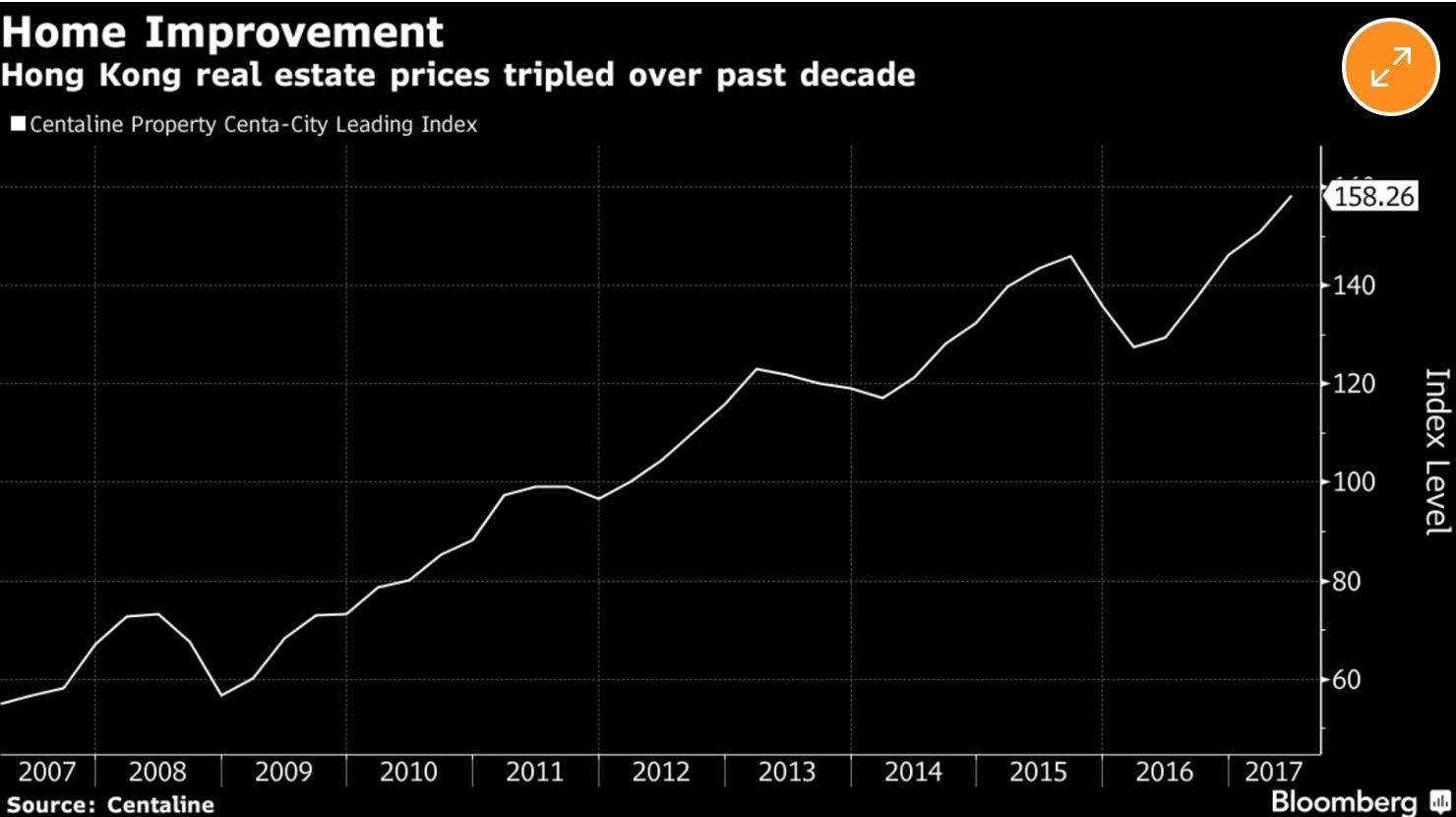
Earlier this year, two mainland Chinese companies outbid Hong Kong’s biggest developers for a waterfront site in Ap Lei Chau, a tiny island just south of HK island for a record HK$16.9bn (US$2.2bn).
According to Bloomberg’s estimates, it amounts to a price of HK$22100 per square foot. This is just the cost of the land – the selling price per square foot is almost certain to exceed HK$30000 when it goes to market.
HK housing prices are approaching their peak and economically unsustainable, said Cusson Leung, managing director at JP Morgan Chase & Co.’s Asia-Pacific equity research unit.
“Price increases have far outpaced GDP growth. Thus any external shocks could trigger tighter liquidity in the city’s banking system,” Leung says. Though the government has introduced measures to rein in the housing market by, for example, doubling the stamp duty tax from 8% to 15% for secondary and foreign home buyers in November last year, prices continued their upward march with no clear signs of slowing down in the near term.
Though the government has introduced measures to rein in the housing market, for example doubling the stamp duty tax from 8% to 15% for secondary and foreign home buyers in November last year, prices continued its upward march with no clear signs of slowing down in the near term.
Government policies are subject to enforcement and impact lag. These lags give people the opportunity to act before the new rules set in. When the Hong Kong government announced the increase in stamp duty, house prices went up rather than down because investors want to avoid paying taxes, which led to a sudden rush of demand to snap up properties before the tax hit them hard.
Hong Kong’s wealthy home buyers have found ways around these curbs and add to their already big portfolios. For example, purchasing multiple properties under one contract under their children’s name would qualify them as a first-time home buyer. Additionally, one can set up a foreign shell company that purchases the property and then buying the shell company that subjects them to only a 0.2% stamp duty since it is treated as a share transfer.
In fact, the number of first-time home buyers has increased from 30% to 70% after the tax was introduced. Since then, the government has closed the loophole such that purchasing multiple units with one contract at the same time would trigger the 15% stamp duty.
At the most basic level, housing is shelter: it is a place where one can safely sleep at night. But housing has transcended this simple definition to being an investment class that provides an alternative to equities and bonds.
People have different reasons for investing in housing. Some want to be landlords to rent out properties for a steady income; others may want to simply diversify their portfolio of assets away from traditional investment classes.
As such, housing has become an instrument for speculative investment. In Hong Kong, even public housing is not spared because existing public housing owners can sell their units on the secondary market, albeit with some conditions, where the price is ultimately tied to prevailing market prices for private housing.
The unaffordable housing adds to the growing discontent among the youth population in Hong Kong. Based on government data, there is at least a four-year waiting list for public housing units. The government has not been able to increase supply enough to offset demand, but more importantly, the idea of using housing to speculate increases in value needs to be changed.
If we assume the government can increase public housing supply free of political setbacks, one idea is to create separate markets between private and public housing. Under this idea, public housing units can only be resold at face value adjusted for core inflation, meaning that prices would not outpace real income, generating price stability and affordability.
Short to medium term remedies will need to contain an element which restricts speculative behaviour. Another idea is to increase the degree of illiquidity in the secondary home market, preventing speculative purchase and sale of properties.
For example, property buyers cannot list their properties for sale for at least ten years after the purchase date. This could also have an effect on the primary market because restricting flexibility in property transactions lowers the value of the property to investors because there is uncertainty on whether they can sell at the right time.
As astonishing as this may sound, much of Hong Kong’s land is undeveloped. Only 30% of HK’s total land area has been built on. In a recent interview on TVB Pearl’s ‘Straight Talk’ with host Michael Chugani, guest interviewee Mr. Shih Wing-ching, the founder and CEO of Centaline Property Agency, suggests that the government has a lot of spare land available. Developments using this land could enormously increase the supply of housing since residential buildings account for only 7% of Hong Kong’s land, of which 3% is public, and 4% is private.
There is strong economic interest for the HK government to not accelerate development because land and real estate is an important source of tax revenue. In FY2016-2017, the sum of stamp duties (10.8%) and premium from land sales (22.3%) accounted for nearly a third of government revenue for the year.
With the right policies, willingness of the government to use its resources, and consensus from the public, Hong Kong’s housing problems can be solved.
However, the messy state of Hong Kong politics has made progress difficult. Referring to Shih Wing-ching’s interview, he points to grim prospects that house prices will fall to a level such that ordinary citizens can afford to buy a property simply because the wealthy still demand property at current prices.
Unlike the previous housing supercycles of boom and bust such as those that followed the SARS outbreak in 2003 and the financial crisis in 2007, current prices look like they are going to stay for a while.
The former British colony’s housing market, while already recognised as the most unaffordable in the world for seven years in a row, continues to make record highs through the combination of investment from cash-rich mainland developers, low interest rates and a shortage of housing supply.
Earlier this year, two mainland Chinese companies outbid Hong Kong’s biggest developers for a waterfront site in Ap Lei Chau, a tiny island just south of HK island for a record HK$16.9bn (US$2.2bn).
According to Bloomberg’s estimates, it amounts to a price of HK$22100 per square foot. This is just the cost of the land – the selling price per square foot is almost certain to exceed HK$30000 when it goes to market.
Economically Unsustainable
HK housing prices are approaching their peak and economically unsustainable, said Cusson Leung, managing director at JP Morgan Chase & Co.’s Asia-Pacific equity research unit.
“Price increases have far outpaced GDP growth. Thus any external shocks could trigger tighter liquidity in the city’s banking system,” Leung says. Though the government has introduced measures to rein in the housing market by, for example, doubling the stamp duty tax from 8% to 15% for secondary and foreign home buyers in November last year, prices continued their upward march with no clear signs of slowing down in the near term.
Tax Evasion
Though the government has introduced measures to rein in the housing market, for example doubling the stamp duty tax from 8% to 15% for secondary and foreign home buyers in November last year, prices continued its upward march with no clear signs of slowing down in the near term.
Government policies are subject to enforcement and impact lag. These lags give people the opportunity to act before the new rules set in. When the Hong Kong government announced the increase in stamp duty, house prices went up rather than down because investors want to avoid paying taxes, which led to a sudden rush of demand to snap up properties before the tax hit them hard.
Hong Kong’s wealthy home buyers have found ways around these curbs and add to their already big portfolios. For example, purchasing multiple properties under one contract under their children’s name would qualify them as a first-time home buyer. Additionally, one can set up a foreign shell company that purchases the property and then buying the shell company that subjects them to only a 0.2% stamp duty since it is treated as a share transfer.
In fact, the number of first-time home buyers has increased from 30% to 70% after the tax was introduced. Since then, the government has closed the loophole such that purchasing multiple units with one contract at the same time would trigger the 15% stamp duty.
Evolution of Housing
At the most basic level, housing is shelter: it is a place where one can safely sleep at night. But housing has transcended this simple definition to being an investment class that provides an alternative to equities and bonds.
People have different reasons for investing in housing. Some want to be landlords to rent out properties for a steady income; others may want to simply diversify their portfolio of assets away from traditional investment classes.
As such, housing has become an instrument for speculative investment. In Hong Kong, even public housing is not spared because existing public housing owners can sell their units on the secondary market, albeit with some conditions, where the price is ultimately tied to prevailing market prices for private housing.
The unaffordable housing adds to the growing discontent among the youth population in Hong Kong. Based on government data, there is at least a four-year waiting list for public housing units. The government has not been able to increase supply enough to offset demand, but more importantly, the idea of using housing to speculate increases in value needs to be changed.
Solutions
If we assume the government can increase public housing supply free of political setbacks, one idea is to create separate markets between private and public housing. Under this idea, public housing units can only be resold at face value adjusted for core inflation, meaning that prices would not outpace real income, generating price stability and affordability.
Short to medium term remedies will need to contain an element which restricts speculative behaviour. Another idea is to increase the degree of illiquidity in the secondary home market, preventing speculative purchase and sale of properties.
For example, property buyers cannot list their properties for sale for at least ten years after the purchase date. This could also have an effect on the primary market because restricting flexibility in property transactions lowers the value of the property to investors because there is uncertainty on whether they can sell at the right time.
As astonishing as this may sound, much of Hong Kong’s land is undeveloped. Only 30% of HK’s total land area has been built on. In a recent interview on TVB Pearl’s ‘Straight Talk’ with host Michael Chugani, guest interviewee Mr. Shih Wing-ching, the founder and CEO of Centaline Property Agency, suggests that the government has a lot of spare land available. Developments using this land could enormously increase the supply of housing since residential buildings account for only 7% of Hong Kong’s land, of which 3% is public, and 4% is private.
There is strong economic interest for the HK government to not accelerate development because land and real estate is an important source of tax revenue. In FY2016-2017, the sum of stamp duties (10.8%) and premium from land sales (22.3%) accounted for nearly a third of government revenue for the year.
With the right policies, willingness of the government to use its resources, and consensus from the public, Hong Kong’s housing problems can be solved.
However, the messy state of Hong Kong politics has made progress difficult. Referring to Shih Wing-ching’s interview, he points to grim prospects that house prices will fall to a level such that ordinary citizens can afford to buy a property simply because the wealthy still demand property at current prices.
Unlike the previous housing supercycles of boom and bust such as those that followed the SARS outbreak in 2003 and the financial crisis in 2007, current prices look like they are going to stay for a while.
Hong Kong and Singapore: Battle of Giants [Published on January 2017]
Traditionally, Hong Kong and Singapore compete in many areas, including education and the quality of their trading ports. However, the cornerstone for (and subsequently a major area of) competition between both cities is their respective financial services sectors.
Despite their similarities, the development paths and comparative advantages of their respective financial centres are significantly different. While Hong Kong’s position as an international financial centre (IFC) was already established as early as the 1960s, as Singapore was just starting its first Asian currency market.
While Hong Kong remains unchallenged today in terms of Initial Public Offerings (IPOs) and mergers and acquisitions (M&A) activity (third overall, just behind London and New York, while Singapore lags in 19th place), Singapore’s rapid growth allowed it to dominate the region when it comes to commodities and foreign exchange trading.
This is not limited to competitiveness in the financial sector. In this years’ Global Competitiveness Index by the World Economic Forum, Hong Kong once again ranked below Singapore, the latter having come second and the former having dropped two places to ninth. Considering the components of this index further, the ‘Financial Market Development’ component also sees Singapore beating Hong Kong, albeit with a margin of 0.1 or 1.82%. While these rankings do not necessarily conclude which country is better, it serves as a good indicator of Hong Kong’s declining competitiveness in Asia as an IFC.
What makes a country or city an international financial centre? What makes IFCs is defined by many factors. They are notable for the competitiveness of their financial industries, highly-developed infrastructure and human capital, relatively unstrict regulatory environments, low taxes, and significant inward foreign direct investment.
For many years, Hong Kong’s international reputation comes from this cocktail that makes it an attractive destination for business. As evidence, many international firms set up their Asian headquarters in Hong Kong. It even has a skyscraper named the International Finance Centre in its financial district. But Singapore’s unprecedented growth sends warning signals that Hong Kong must improve or reinvent itself if it is to regain its throne as Asia’s financial lynchpin.
If there is an area in which Hong Kong has an absolute advantage over Singapore, it is its strong links and proximity to mainland China. Its growth story surpasses these two Asian dragons if one compares the extreme difficulty in managing a country of China’s size. Because of this, the Hong Kong Monetary Authority and Hong Kong Exchanges and Clearing have in the last two decades shifted the focus of their development strategies to China. Hong Kong is the world’s largest offshore renminbi exchange centre, taking up a staggering
Because of this, the Hong Kong Monetary Authority and Hong Kong Exchanges and Clearing have in the last two decades shifted the focus of their development strategies to China. Hong Kong is the world’s largest offshore renminbi exchange centre, taking up a staggering 70% of total transaction value for the Chinese currency.
Furthermore, as of October 31st, 2016, of the total number of listed companies on the Hong Kong stock exchange (1955) more than half (989) are based on the mainland. Strategic initiatives are known as the ‘Shanghai-HK Stock Connect’ and ‘Shenzhen-HK Stock Connect’, and have opened foreign investors into mainland-issued A-shares. Without China, Hong Kong would have at some point got stuck in a permanent economic slump.
Singapore is already feeling the strain, with the economy probably recording its “worst performance since the 2009 financial crisis". Both export-reliant, the two economies are vulnerable to external trade shocks, and higher US interest rates affecting capital flows into their respective economies. What is certain is that the title of Asia’s premier financial centre is up for grabs.
http://www3.weforum.org/docs/GCR2016-2017/05FullReport/TheGlobalCompetitivenessReport2016-2017_FINAL.pdf
http://www3.weforum.org/docs/gcr/2015-2016/Global_Competitiveness_Report_2015-2016.pdf
http://reports.weforum.org/global-competitiveness-report-2015-2016/competitiveness-rankings/#indicatorId=GCI.B.08
http://www.legco.gov.hk/research-publications/english/essentials-1516ise08-competitiveness-of-hong-kong-in-offshore-renminbi-business.htm
Grounded in Finance
Financial and insurance services (FIS) contributed approximately 24.5% of total services exports in Hong Kong in 2015. Meanwhile, FIS was one of the main drivers of 2015 real GDP growth in Singapore, contributing 0.7% to the total recorded figure of 2%. These figures highlight the economic importance of this sector to both economies.Despite their similarities, the development paths and comparative advantages of their respective financial centres are significantly different. While Hong Kong’s position as an international financial centre (IFC) was already established as early as the 1960s, as Singapore was just starting its first Asian currency market.
While Hong Kong remains unchallenged today in terms of Initial Public Offerings (IPOs) and mergers and acquisitions (M&A) activity (third overall, just behind London and New York, while Singapore lags in 19th place), Singapore’s rapid growth allowed it to dominate the region when it comes to commodities and foreign exchange trading.
Hot Competition
So how do they compare with each other? In the Global Financial Centres Index (GFCI) published by Z/Yen Group, which assesses the competitiveness of a country’s financial sector, Hong Kong ranked ahead of Singapore on sixteen out of twenty measures. But Singapore has overtaken Hong Kong to reach third place overall and remained in this position for the whole of 2016.This is not limited to competitiveness in the financial sector. In this years’ Global Competitiveness Index by the World Economic Forum, Hong Kong once again ranked below Singapore, the latter having come second and the former having dropped two places to ninth. Considering the components of this index further, the ‘Financial Market Development’ component also sees Singapore beating Hong Kong, albeit with a margin of 0.1 or 1.82%. While these rankings do not necessarily conclude which country is better, it serves as a good indicator of Hong Kong’s declining competitiveness in Asia as an IFC.
What makes a country or city an international financial centre? What makes IFCs is defined by many factors. They are notable for the competitiveness of their financial industries, highly-developed infrastructure and human capital, relatively unstrict regulatory environments, low taxes, and significant inward foreign direct investment.
For many years, Hong Kong’s international reputation comes from this cocktail that makes it an attractive destination for business. As evidence, many international firms set up their Asian headquarters in Hong Kong. It even has a skyscraper named the International Finance Centre in its financial district. But Singapore’s unprecedented growth sends warning signals that Hong Kong must improve or reinvent itself if it is to regain its throne as Asia’s financial lynchpin.
70% of RMB’s transaction value is Hong Kong-based
If there is an area in which Hong Kong has an absolute advantage over Singapore, it is its strong links and proximity to mainland China. Its growth story surpasses these two Asian dragons if one compares the extreme difficulty in managing a country of China’s size. Because of this, the Hong Kong Monetary Authority and Hong Kong Exchanges and Clearing have in the last two decades shifted the focus of their development strategies to China. Hong Kong is the world’s largest offshore renminbi exchange centre, taking up a staggering
Because of this, the Hong Kong Monetary Authority and Hong Kong Exchanges and Clearing have in the last two decades shifted the focus of their development strategies to China. Hong Kong is the world’s largest offshore renminbi exchange centre, taking up a staggering 70% of total transaction value for the Chinese currency.
Furthermore, as of October 31st, 2016, of the total number of listed companies on the Hong Kong stock exchange (1955) more than half (989) are based on the mainland. Strategic initiatives are known as the ‘Shanghai-HK Stock Connect’ and ‘Shenzhen-HK Stock Connect’, and have opened foreign investors into mainland-issued A-shares. Without China, Hong Kong would have at some point got stuck in a permanent economic slump.
A Title up for Grabs
It is possible that the new Trump-led US economy is likely to have significant effects on both Hong Kong and Singapore, due to the increasing uncertainty in emerging markets. China’s trade relationship with the US, amongst other things, could very well take a turn for the worse – leaving Hong Kong worse-off in the process.Singapore is already feeling the strain, with the economy probably recording its “worst performance since the 2009 financial crisis". Both export-reliant, the two economies are vulnerable to external trade shocks, and higher US interest rates affecting capital flows into their respective economies. What is certain is that the title of Asia’s premier financial centre is up for grabs.
Sources:
https://www.mti.gov.sg/ResearchRoom/SiteAssets/Pages/Economic-Survey-of-Singapore-2015/FullReport_AES2015.pdf http://www3.weforum.org/docs/GCR2016-2017/05FullReport/TheGlobalCompetitivenessReport2016-2017_FINAL.pdf
http://www3.weforum.org/docs/gcr/2015-2016/Global_Competitiveness_Report_2015-2016.pdf
http://reports.weforum.org/global-competitiveness-report-2015-2016/competitiveness-rankings/#indicatorId=GCI.B.08
Sunday, January 6, 2019
Why Central Banks Should Surprise Markets [Published on July 2016]
Volatile financial markets, which is a by-product of uncertainty in fundamental signals in economics or politics, offer investors a rare opportunity to earn big money. However, the migration to what investors regard as ‘safe haven’ assets shed light on the risk-averse investment behaviors, especially due to the risks from ‘Brexit’ and the rise of Republican Nominee Donald Trump recently. For example, in the months leading up to and on the day of the ‘Brexit’ vote, the Japanese Yen outperformed against all other major currencies, and Gold has surged over 22% since January.
Long story short, volatility is not good in the eyes of policymakers. It makes investors cautious about risky assets (i.e. stocks) which reduce business investment, GDP growth, and wage growth. Central banks have traditionally played the role of leading and stabilizing markets through the use of Forward Guidance, a key Central Bank policy tool to announce the expected path of interest rate to traders and investors.
If you have read my previous article here, I argued that the advancements in the financial markets over time have partially displaced power from policymakers to investors. Large amounts of information have fundamentally changed investors’ behaviors from merely being responsive to speculative in the markets. Speculation involves making predictions; forward-looking investors make their investments today in anticipation of a favorable situation to which they could profit from in the future. The danger of speculation is that it could become manipulation; in effect, the market dictates the action of policymakers because any significant decision must be carefully evaluated against the economic indicators, and that includes signals from the markets.
Let us travel back in time to January 2016, during the first Federal Open Market Committee (FOMC) meeting. The US economy started the year strongly, with consumer spending, wages and inflation picking up from the previous quarter, suggesting the economy is robust enough to endure a planned rate hike in June. Flash forward several months to May, the bond market issues an ominous warning by a flattening of the yield curve depicted by the shrinking gap in yield between the 2-year and 10-year Treasury bonds in the graph below:
The flattening of the yield curve often coincides with a recession, however, economists were not worried about the impact on the U.S. economy, but the world economy. The market predicted that a rate hike in June would have a negative impact on world economies enduring sluggish growth and uncertain political landscapes, and priced the market accordingly. In the end, the Federal Reserve refrained from raising rates. Here are the two extracts from the Wall Street Journal that elaborates on this:
- Favourable 2016 economic data - http://www.wsj.com/articles/u-s-growth-revised-higher-in-fourth-quarter-1456493673
- Flattening yield curve - http://blogs.wsj.com/moneybeat/2016/05/24/signals-from-the-u-s-yield-curve-world-cant-handle-fed-rate-hikes/
Here is an interesting method: what if Central Banks were to intentionally surprise markets?
It is certainly a controversial idea, but it is not completely irrational. An element of unpredictability is necessary when markets need to be corrected to achieve policy targets. Compared to QE and negative interest rates, this is about as unconventional as it gets for Central Bank policy. We will do a case study on the Bank of Japan (BOJ) and the Yen. Below is a 5-year chart of the USDJPY (2011 - 2016):

One of the policies that Prime Minister Shinzo Abe advocated is monetary stimulus; under economic theory, the stimulus would make it cheaper to borrow, increase consumption and inflation, and depreciate the yen to make exports more competitive. When BOJ governor Haruhiko Kuroda took office in March 2013, he immediately surprised by announcing his plan to increase the monthly bond purchase program to 7.5 trillion yen and double the monetary base. Because the stimulus was greater than expected, markets took the news positively Yen depreciated very sharply by 8 percent, and continued to depreciate with speculation of further stimulus. This was a minor success in prime minister Abe’s economic goals to fuel export competitiveness.
However, three years of underwhelming economic data have changed the market’s mind, thereby signaling the Yen to reverse its downtrend. The Yen’s appreciation is exacerbated by its safe haven from the aforementioned risks. Kuroda surprised again at the beginning of 2016 by setting the benchmark interest rate to minus 0.1%. This time, the Yen fell on the announcement, but it did little to re-instill confidence in the BOJ’s easing policies to arrest deflation as it kept its asset purchase program unchanged. In this scenario, the aggregate effect did not exceed expectations and therefore did not alter the markets’ overall sentiment.
For Central Banks to influence markets it has to exceed market expectations through a ‘positive’ surprise. This particular case in the BOJ can be applied to the European Central Bank (ECB) when it cut rates and expanded QE in March 2016. Initially, the Euro fell over 1.6% against the US Dollar on the announcement but rebounded to end the day 0.6% higher after prospects of further stimulus is cut short.
One might sympathize with the Central Banks because it has been a scapegoat for scrutiny by investors that feel they betrayed their expectations to offer more stimulus. It also does not help when they continue to be at the center of attention because of QE and negative interest rate experiments. Clearly, the Central Bank cannot go at it alone; effective policy requires a simultaneous input from both fiscal and monetary tools. The coordination of both sets of tools has been disappointing. Mr. Mohammed El-Erian, the former CEO of PIMCO and a Bloomberg View Columnist, has continually expressed that well-constructed fiscal policy and structural reforms have been lacking.
Ultimately, the decision on whether to calm or jolt the market is hugely dependent on the macroeconomic effects that policymakers desire. The ideal weapon is coordinating fiscal and monetary policy together to convey a strong and confident message to the markets, but this is not always possible because of the ‘implementation lag’ between both tools. In light of this, the Central Bank should have the courage to occasionally remind the market that it is still a force to be reckoned with in an era where the effects of monetary policy are straying away from the forces of economics.
Sources:
http://www.bloomberg.com/news/articles/2013-04-04/bank-of-japan-boosts-bond-purchases-at-kuroda-s-first-meeting
http://www.bloomberg.com/news/articles/2016-03-10/ecb-cuts-all-rates-as-qe-boosted-to-80-billion-euros-a-month
Achieving greater economic growth from housing bubbles [Published on November 2016]
One of the most basic models learned in introductory macroeconomics courses was the real business cycle, which shows GDP fluctuating cyclically over time between growth and recession. The graph below illustrates the GDP growth rate (%) for G7 countries, obtained from the World Bank. We can observe that GDP growth rate behaves cyclically, fluctuating between periods of economic growth and decline.
 (Source: The World Bank)
One of the strongest indicators of an economy’s performance is its housing prices. Theory says that when an economy is performing well, the rise in income spurs investment/savings in tangible assets. In major cities that are the main driver of the country’s economic growth, that income goes into either buying or renting real estate. We compare the House Price Index and GDP per capita (in USD) from The Economist and World Bank respectively. The dataset spans from 1990 onwards. Apart from Japan and Germany, we can observe that the house price index of the G7 countries is positively correlated with GDP per capita. There are possible explanations for these two anomalies. Japan’s negative correlation between the two indicators was caused by misguided government policies in the late 1980s and external shocks that resulted in the sharp asset price falls contributing to the ‘Lost Decade’, while Germany’s near-zero correlation was due to the German reunification expanding the supply of land that countered demand-side pressure.


Housing bubbles are typically generated from excessive demand for the slow-changing supply of housing resulting from optimism and speculation. This causes house prices to rise due to the natural forces of economics to restore equilibrium. In the current, prolonged low-interest rate environment that facilitates cheap borrowing, investment in tangible assets are popular as opposed to negative-yielding bonds and expensive equities. An article from CNBC reports that housing prices in Vancouver, London, Stockholm, Hong Kong, Sydney, and Munich have risen by over 50% on average since 2011, quoting research from UBS AG. In these cities, predatory behaviour of households is evident; These predators or ‘rent-seeking’ individuals use property effectively as a tax on capital accumulation and reducing a fraction of total output. Resources, time and people, are diverted away from production into protection**.
**Development Economics, Model of Predation – protection refers to the time allocated towards non-productive activities
With the most recent global financial crisis caused directly by the housing market boom and bust, and the association of real estate to the wealthy minority, housing bubbles are perceived to be undesirable. House price appreciations are associated with higher economic growth, reflecting the cyclical nature of GDP growth. However, the subsequent correction after the bubble can either undermine or stimulate economic growth and productivity depending on the depth of the correction and the market environment.
This is part of a recent academic paper by my supervising professor at The Chinese University of Hong Kong. The analysis conducted looks at 19 countries between the first quarter of 1975 to the third quarter of 2013. Depreciation leads to both higher GDP growth and productivity growth. Taking the results from the primary two-stage least squares Instrumental Variable regression, it was found that large housing price depreciation (>10% decline) increase GDP growth by about 3 basis points on average. Meanwhile, moderate depreciations (<10% decline) reduces GDP growth by 3.5 basis points on average. This correlation is consistent in 17 of the 19 countries analyzed, with the two anomalies being Japan and Germany for the aforementioned reasons. These findings hold in the absence of a banking/credit crisis.
The main causal interpretation revolves around the reallocation of resources. Capital gets reallocated from unproductive housing sector into more efficient sectors following house price depreciation, with accommodative policies to prevent a credit crisis. Zombie lending distorts capital allocation and depresses growth. These firms would less likely be able to survive when house prices face steep corrections. The magnitude of this depreciation mechanism on economic growth depends on underwater mortgages, the level of protection for investors, and the country’s legal system. Countries with underwater mortgages, no personal bankruptcy, and/or mortgage insurance, and follow a civil law system are positively and significantly associated with stronger economic growth and productivity growth following steep housing price corrections. Underwater mortgages and a weak ‘safety net’ for investors improve the allocative efficiency of labour.
The nature of housing markets is very similar to the cyclical nature of GDP, experiencing booms and busts resulting from disequilibrium in the market fueled by speculation. Housing bubbles are widely perceived to be inherently dangerous due to speculative behaviour. However, what happens after the housing bubble can lead to a more robust economy driven by stronger fundamentals.
Sources:
http://www.cnbc.com/2016/10/04/these-6-cities-are-at-the-greatest-risk-of-housing-market-bubbles-commentary.html
http://data.worldbank.org/indicator/NY.GDP.MKTP.KD.ZG?end=2015&locations=US-GB-JP-CA-DE-IT-FR&name_desc=true&start=1965&view=chart
http://www.economist.com/blogs/dailychart/2011/11/global-house-prices

One of the strongest indicators of an economy’s performance is its housing prices. Theory says that when an economy is performing well, the rise in income spurs investment/savings in tangible assets. In major cities that are the main driver of the country’s economic growth, that income goes into either buying or renting real estate. We compare the House Price Index and GDP per capita (in USD) from The Economist and World Bank respectively. The dataset spans from 1990 onwards. Apart from Japan and Germany, we can observe that the house price index of the G7 countries is positively correlated with GDP per capita. There are possible explanations for these two anomalies. Japan’s negative correlation between the two indicators was caused by misguided government policies in the late 1980s and external shocks that resulted in the sharp asset price falls contributing to the ‘Lost Decade’, while Germany’s near-zero correlation was due to the German reunification expanding the supply of land that countered demand-side pressure.

(Source: The World Bank)

(Source: The Economist)
Housing bubbles are typically generated from excessive demand for the slow-changing supply of housing resulting from optimism and speculation. This causes house prices to rise due to the natural forces of economics to restore equilibrium. In the current, prolonged low-interest rate environment that facilitates cheap borrowing, investment in tangible assets are popular as opposed to negative-yielding bonds and expensive equities. An article from CNBC reports that housing prices in Vancouver, London, Stockholm, Hong Kong, Sydney, and Munich have risen by over 50% on average since 2011, quoting research from UBS AG. In these cities, predatory behaviour of households is evident; These predators or ‘rent-seeking’ individuals use property effectively as a tax on capital accumulation and reducing a fraction of total output. Resources, time and people, are diverted away from production into protection**.
**Development Economics, Model of Predation – protection refers to the time allocated towards non-productive activities
This is part of a recent academic paper by my supervising professor at The Chinese University of Hong Kong. The analysis conducted looks at 19 countries between the first quarter of 1975 to the third quarter of 2013. Depreciation leads to both higher GDP growth and productivity growth. Taking the results from the primary two-stage least squares Instrumental Variable regression, it was found that large housing price depreciation (>10% decline) increase GDP growth by about 3 basis points on average. Meanwhile, moderate depreciations (<10% decline) reduces GDP growth by 3.5 basis points on average. This correlation is consistent in 17 of the 19 countries analyzed, with the two anomalies being Japan and Germany for the aforementioned reasons. These findings hold in the absence of a banking/credit crisis.
The main causal interpretation revolves around the reallocation of resources. Capital gets reallocated from unproductive housing sector into more efficient sectors following house price depreciation, with accommodative policies to prevent a credit crisis. Zombie lending distorts capital allocation and depresses growth. These firms would less likely be able to survive when house prices face steep corrections. The magnitude of this depreciation mechanism on economic growth depends on underwater mortgages, the level of protection for investors, and the country’s legal system. Countries with underwater mortgages, no personal bankruptcy, and/or mortgage insurance, and follow a civil law system are positively and significantly associated with stronger economic growth and productivity growth following steep housing price corrections. Underwater mortgages and a weak ‘safety net’ for investors improve the allocative efficiency of labour.
The nature of housing markets is very similar to the cyclical nature of GDP, experiencing booms and busts resulting from disequilibrium in the market fueled by speculation. Housing bubbles are widely perceived to be inherently dangerous due to speculative behaviour. However, what happens after the housing bubble can lead to a more robust economy driven by stronger fundamentals.
Sources:
http://www.cnbc.com/2016/10/04/these-6-cities-are-at-the-greatest-risk-of-housing-market-bubbles-commentary.html
http://data.worldbank.org/indicator/NY.GDP.MKTP.KD.ZG?end=2015&locations=US-GB-JP-CA-DE-IT-FR&name_desc=true&start=1965&view=chart
http://www.economist.com/blogs/dailychart/2011/11/global-house-prices
Saturday, January 5, 2019
The New ‘Normal’ of the Chinese Economy [First published on November 2015]
The Chinese economy, now headed for its slowest growth in 25 years, continues to top headlines in more ways than one. Commodities are continuing to endure the slump; according to the Bloomberg Commodities Price Index, the performance of commodities “has plunged two-thirds its peak in 2008, to the lowest level since 1999”, strictly confirming that the commodity super-cycle that is heavily-rooted from Chinese demand has finally ran its course. China is the second largest economy, with a gross domestic product of $10 trillion, just behind the United States; it is undoubtedly categorized as an economic superpower, such that China’s slowdown negatively impacts the world economy. Ironically, although the Chinese slowdown does not bode well for markets or the world economy, it is positive news for China.
Despite being the second largest economy in the world, China is classified as a developing economy according the World Bank. Using this definition as a benchmark, the Chinese economy has achieved extraordinary growth in the last several decades, with an average annualized GDP growth rate of 9.83% since 2001, and growing as much as 14.2% in 2007. This rapid pace of growth was considered normal for a developing economy, with astrong emphasis placed on development of infrastructure and the manufacturing industry. Foreign investors hungry for high yields, and businesses aiming to maximize profit margins had their eyes glued on China for its growth potential and low production costs respectively. The world economy’s dependence on China, supplemented with its classification as a developing economy created expectations within investors that the Chinese economy will keep churning out double figure growth rates. However, China has not achieved growth of over 10% since 2010 (10.6%), and it is pertinent to think it is the last time that China will produce growth of this level for the foreseeable future.
Wall Street’s biggest names have weighed-in their opinions on the implications of the Chinese slowdown. Goldman Sachs Chief Executive Officer Lloyd C. Blankfein, says “the economic model that drove China’s growth… won’t necessarily support it in the next couple of decades.” Newly elected Chief Executive Officer of Credit Suisse Tidjane Thiam offered his insights into the Chinese economic slowdown on markets when he spoke on Bloomberg <GO>. “I actually welcome the slowdown” he says. “China was not going to grow at 10% forever, the market told itself a narrative that is simply not true.” The markets, influenced by investors’ over-expectations of the Chinese economy, have pushed fundamental market prices such as commodities too high, and is therefore experiencing the current slump. Furthermore, Mr. Thiam states, “China has experienced quantitative growth, and now they are going to have qualitative growth. Growing between 4-6% is healthy because it resets expectations at a reasonable level.” The percentage growth expression can be misleading because China’s economy today is much greater than in the last decade, so in absolute terms, growth is actually larger today compared to before.
Rapid economic growth has brought prosperity to the Chinese (not to mention foreign investors), but has also brought about new challenges. Firstly, environmental sustainability is a long-term problem that needs to be addressed; according to China’s National Bureau of statistics, “about 90 percent of the 161 cities whose air quality was monitored failed to meet official standards.” Secondly, economic inequality is large and increasingin China even after decades of growth, with the Gini Coefficient estimated at 46.9 according to the CIA. Finally, external debt is at more than 200% of gross domestic product, and leverage is still growing despite efforts to deleverage, which could potentially wipe out the economy if private sector companies default. If the rate of growth, strategy for growth, and type of growth remain unchanged, the Chinese economy would be aggravated with these symptoms in the long-run.
Finance Minister Lo Ji Wei said in an official statement on the People’s Bank of China website, that 7% is the new ‘normal’. The World Banks’ overview of China states “its annual growth target of 7 percent signals the intention to focus on quality of life, rather than pace of growth.” The modern Chinese economy is experiencing structural changes to its development model and industries. According to Bloomberg, consumption exceeds investment in terms of contribution to economic growth at around 60%. Government funds are being allocated to projects that improve standard of living such as energy conservation, high-speed transportation in rural areas, and environmental protection. Moreover, China is showing signs of switching from a secondary(manufacturing) economy to a tertiary (service) economy that is driven by the growth in e-commerce and technology firms. The quality of human capital is increasing with better education. Better-educated individuals refrain from jobs in manufacturing, and instead create their own start-ups or join large corporations in the service industry.
In thereafter, to illustrate this phenomenon with an example, imagine that economies are similar to cars poweredby engines. Maxing out the engine would make the car go faster, but the engine would most likely last for a short period of time. Keeping a moderate pace would sustain the engine’s functionality and quality. Overall, China is easing-off the accelerator pedal as embraces the structural changes to sustain its engine for the future.
Despite being the second largest economy in the world, China is classified as a developing economy according the World Bank. Using this definition as a benchmark, the Chinese economy has achieved extraordinary growth in the last several decades, with an average annualized GDP growth rate of 9.83% since 2001, and growing as much as 14.2% in 2007. This rapid pace of growth was considered normal for a developing economy, with astrong emphasis placed on development of infrastructure and the manufacturing industry. Foreign investors hungry for high yields, and businesses aiming to maximize profit margins had their eyes glued on China for its growth potential and low production costs respectively. The world economy’s dependence on China, supplemented with its classification as a developing economy created expectations within investors that the Chinese economy will keep churning out double figure growth rates. However, China has not achieved growth of over 10% since 2010 (10.6%), and it is pertinent to think it is the last time that China will produce growth of this level for the foreseeable future.
Wall Street’s biggest names have weighed-in their opinions on the implications of the Chinese slowdown. Goldman Sachs Chief Executive Officer Lloyd C. Blankfein, says “the economic model that drove China’s growth… won’t necessarily support it in the next couple of decades.” Newly elected Chief Executive Officer of Credit Suisse Tidjane Thiam offered his insights into the Chinese economic slowdown on markets when he spoke on Bloomberg <GO>. “I actually welcome the slowdown” he says. “China was not going to grow at 10% forever, the market told itself a narrative that is simply not true.” The markets, influenced by investors’ over-expectations of the Chinese economy, have pushed fundamental market prices such as commodities too high, and is therefore experiencing the current slump. Furthermore, Mr. Thiam states, “China has experienced quantitative growth, and now they are going to have qualitative growth. Growing between 4-6% is healthy because it resets expectations at a reasonable level.” The percentage growth expression can be misleading because China’s economy today is much greater than in the last decade, so in absolute terms, growth is actually larger today compared to before.
Rapid economic growth has brought prosperity to the Chinese (not to mention foreign investors), but has also brought about new challenges. Firstly, environmental sustainability is a long-term problem that needs to be addressed; according to China’s National Bureau of statistics, “about 90 percent of the 161 cities whose air quality was monitored failed to meet official standards.” Secondly, economic inequality is large and increasingin China even after decades of growth, with the Gini Coefficient estimated at 46.9 according to the CIA. Finally, external debt is at more than 200% of gross domestic product, and leverage is still growing despite efforts to deleverage, which could potentially wipe out the economy if private sector companies default. If the rate of growth, strategy for growth, and type of growth remain unchanged, the Chinese economy would be aggravated with these symptoms in the long-run.
Finance Minister Lo Ji Wei said in an official statement on the People’s Bank of China website, that 7% is the new ‘normal’. The World Banks’ overview of China states “its annual growth target of 7 percent signals the intention to focus on quality of life, rather than pace of growth.” The modern Chinese economy is experiencing structural changes to its development model and industries. According to Bloomberg, consumption exceeds investment in terms of contribution to economic growth at around 60%. Government funds are being allocated to projects that improve standard of living such as energy conservation, high-speed transportation in rural areas, and environmental protection. Moreover, China is showing signs of switching from a secondary(manufacturing) economy to a tertiary (service) economy that is driven by the growth in e-commerce and technology firms. The quality of human capital is increasing with better education. Better-educated individuals refrain from jobs in manufacturing, and instead create their own start-ups or join large corporations in the service industry.
In thereafter, to illustrate this phenomenon with an example, imagine that economies are similar to cars poweredby engines. Maxing out the engine would make the car go faster, but the engine would most likely last for a short period of time. Keeping a moderate pace would sustain the engine’s functionality and quality. Overall, China is easing-off the accelerator pedal as embraces the structural changes to sustain its engine for the future.
Monday, October 19, 2015
Financial Market Advancements, and The Decline of State Manipulation [Published on November 2015]
Eventually, the Federal Reserve chose to keep interest rates unchanged at 0.25%, ending a long-drawn saga of speculation and predictions, and continuing on an even longer saga of historically low-interest rates. Given the outlook for the world economy and some negative U.S. indicators, the majority of analysts on Wall Street predicted that rates would stay the same, despite the Federal Reserve making it strictly clear under their forward guidance policy that rates would increase in September. Janet Yellen and the Federal Reserve board members were not going to make a misstep in their efforts to ensure the U.S. economy is healthy enough to endure a dose of basis point increase after nearly a decade.
However, one fundamental issue gets raised through this episode. Before elaborating on this issue, it’s essential to understand the advance developments in financial markets. Financial markets are at the pinnacle of sophistication in the modern age; information, speed, and efficiency of trading and the range of financial products undoubtedly make this one of humankind's greatest and biggest innovations since the digital revolution. Equities, bonds, currencies, commodities, options, futures, derivatives; anything you want to trade, you can find in this comprehensive library, all at the click of a button on your computer or smartphone. Apart from the initial monetary investment, barriers to entry for financial markets are almost non-existent; everyone has the capacity and freedom to trade. With the flood of newcomers hoping to profit from the markets, information services such as Bloomberg and Thomson Reuters, along with specialized forecasting tools as part of technical analyses, have established their necessity to investors, and increased transparency of financial markets. Long story short, financial markets have come a long way since its humble beginnings.
Financial markets also shine a light on information about the economy. Stock market indices, for example, the S&P500, Dow Jones Industrial or FTSE100, to some degree reflect business cycles; performances from large, public corporations strongly influence consumption, inflation, investment, and unemployment to name a few, and these indices are comprised of these big players. Similarly, the trends in relative strength of a currency to another highlight expectations in future economic performance, for example when China announced a slowdown in growth during the second half of 2014, emerging market currencies that rely heavily on commodity exports slumped, with the AUD, NZD, and CAD having fallen by 22.4%, 22.3%, and 20.4% respectively against the USD as of 17 October 2015.

With this amount of symmetric information, investors speculate and take action in the market based on their expectations of price ups and downs. To profit from speculation, investors have to trade long or short (otherwise it is no different from fortune-telling), and depending on demand and supply, prices will change. With confidence, we can state that investor speculation is dependent on data and information, but could the same be said for government intervention after what had happened last month?
Therefore, the issue is this: “who manipulates markets, investors or the Central bank (representative of government intervention)?” Back to the situation that caused this issue to arise. The Federal Reserve had intended to raise rates on September following sustained improvements in U.S. data but stayed put in the end by unfavourable conditions outside, and incomplete conditions inside of the U.S. economy. However, Janet Yellen maintained her view that a rate hike is still on the cards for this year. Treasury traders, on the other hand, think otherwise, now expecting the increase would be delayed until March 2016, according to the
 10 year U.S. government bond yield term structure shown below.
As written on Bloomberg, “The benchmark 10-year note yield fell seven basis points, or 0.07 percentage point, to 1.97 percent as of 5 p.m. in New York, the lowest on a closing basis since April 27, according to Bloomberg Bond Trader data.” (Full article here). Bond markets, the largest financial market by value, illustrates the market, and therefore investors’ expectations in interest rates.
On the other side of the world in Europe, ECB President Mario Draghi is losing credibility from traders that his monetary policy strategy is weakening the Euro. Neo-classical economics tell us that expansionary monetary policy such as ‘Quantitative Easing’ would depreciate the currency since investors search for higher yields elsewhere, but the Euro has recently experienced a resurgence, up 8.2% from the lowest point ($1.046) as a result of strong data from the Eurozone.

While Mr. Draghi has asserted his intentions for further QE which should keep the Euro in-check, ultimately, the market consensus says otherwise. Even before the QE was announced, the Euro depreciated nearly 33% against the dollar, which implies that investors predicted this move by the ECB. Moreover, investor’s were just utilizing another law from international economics; under the UIP arbitrage theory, the domestic interest rate (i.e. Euro) must be lower than the foreign interest rate (i.e. USD, but other currencies can take its place) by an equal amount of the expected appreciation. Investors speculated that QE would revive the Euro (future appreciation), hence the Euro needed to depreciate in the current period. The same, but the reverse situation could be expressed for the U.S. dollar, where it has outperformed most currencies after the Federal Reserve’s forward guidance indicated an interest rate lift in 2015, and is now experiencing slight downward fluctuations, vexing dollar bulls.
Investors act upon data and forecasts; this is undeniable. Paradoxically, economic-wide data, the most important set of data, is provided by official government agencies. Data on unemployment, nonfarm payrolls, GDP, and inflation, for example, always receive investors’ full attention whenever they are announced. It is difficult (bordering on impossible) to verify the accuracy or legitimacy of data provided by the state; China has raised suspicions upon its GDP statistics on several occasions before. Does this, conversely, suggest that investors are being manipulated by the state? Not necessarily. For example, if the data was bad, what message does the government get across to the public? “I’m not terribly well at doing my job” is the likely opinion. Good data is always merit, and bad data is always bad unless there is merit for the government to publish fabricated data that does not meet expectations.
Investors move the markets, and government intervention significantly affects their decisions; in the past this relationship is one-way. However, with sophisticated analytical techniques, a plethora of instantaneous information and the pressure on economic superpowers to avoid another financial crisis, investors now have a degree of influence over how the economy and financial market plays out.
Tuesday, December 23, 2014
Wages and Inflation - Purchasing Power Factors
Many economies have gone to great lengths, many times excessively, to achieve economic objectives. One of the most focused and discussed, other than unemployment and economic growth, is inflation. The magic number '2.0' is commonplace knowledge among those who follow economic news closely, which refers to universal inflation target of 2%. Governments have introduced numerous policies in order to achieve this target; they are so obsessed with this figure that the Bank of England even organised a policy competition called 'Target 2.0' where contestants devise policies based on the use of monetary policies (interest rates and money supply).
Why is the target inflation rate 2%? Taken from an extract in the offcial website for the Federal Reserve, "[t]he Federal Open Market Committee (FOMC) judges that inflation at the rate of 2 percent (as measured by the annual change in the price index for personal consumption expenditures, or PCE) is most consistent over the longer run with the Federal Reserve's mandate for price stability and maximum employment." I do not know whether this target is derived mathematically or intuitively, but I do know that inflation is a pro-cyclical with the business cycle, meaning that inflation moves in line with GDP growth. Ultimately, economic growth is the main objective of the government regardless of the complex economic situations; modest inflation, low unemployment, positive balance of payments, and sensible fiscal and monetary policies are key determinants of GDP growth.
What affects inflation? Monetary policy. Monetary policy is a set of government policies that focus on the use of interest rates and money supply. The 2007/08 financial crisis, which led to one of the worst recessions in history since the Great Depression through multiple defaults on subprime mortgages that triggered the fall in value of mortgage-backed securities, destroyed $26 trillion U.S. Dollars worth of the financial markets; to put that figure into perspective, it is the equivalent to more than 5 times the UK economy! Policy makers had to act fast amidst the chaos and generate an effective response to the recession. The unanimous decision was to stimulate the economy's consumption and spending through Quantitative Easing (QE), an unconventional monetary policy which aims to keep long term interest rates low. QE first started in Japan back in 2001, when the Bank of Japan tried to fight of a decade of deflation for reasons including aging population, low-priced imported goods, fallen asset prices, and insolvent banks. Low interest rates generate very cheap credit, thus aiming to increase lending by financial institutions and borrowing by consumers and investors that were hit hard by the crisis. It steered America back on course for economic growth, inflation, and low unemployment. After five years of QE, the Federal Reserve decided to halt its asset purchase program after injecting around $4.5 trillion U.S. dollars into its economy. QE is still adopted in the EU and Japan, to fight of economic weakness and deflation respectively.
I would like to direct everyone's attention to the idea of purchasing power and real income. Purchasing power is the value of a currency expressed in terms of the number of units of goods and services that one unit of money can buy. Real income is the amount of income an individual earns adjusted for inflation. These concept is important in showing why the effects of inflation can be countered with increases in wages. For the consumers, the effects on inflation will not have any effect on nominal income (expressed in terms of currency), but would reduce their real income (expressed in terms of purchasing power). In the inflated price environment, consumers would purchase fewer goods with their current income. The only way to reverse this drawback is to increase wages and likewise real income which enables the consumer to continue purchasing its original basket of goods.
This is very similar to the Long Run Phillips Curve, an economic theory which shows that any expansionary policy that aims to lower unemployment would have inflationary effects when unemployment reverts back to its natural rate. Let us look at the correlation in the US economy:
 |
| "Target 2.0" - Unanimous target inflation rate of 2% |
Why is the target inflation rate 2%? Taken from an extract in the offcial website for the Federal Reserve, "[t]he Federal Open Market Committee (FOMC) judges that inflation at the rate of 2 percent (as measured by the annual change in the price index for personal consumption expenditures, or PCE) is most consistent over the longer run with the Federal Reserve's mandate for price stability and maximum employment." I do not know whether this target is derived mathematically or intuitively, but I do know that inflation is a pro-cyclical with the business cycle, meaning that inflation moves in line with GDP growth. Ultimately, economic growth is the main objective of the government regardless of the complex economic situations; modest inflation, low unemployment, positive balance of payments, and sensible fiscal and monetary policies are key determinants of GDP growth.
What affects inflation? Monetary policy. Monetary policy is a set of government policies that focus on the use of interest rates and money supply. The 2007/08 financial crisis, which led to one of the worst recessions in history since the Great Depression through multiple defaults on subprime mortgages that triggered the fall in value of mortgage-backed securities, destroyed $26 trillion U.S. Dollars worth of the financial markets; to put that figure into perspective, it is the equivalent to more than 5 times the UK economy! Policy makers had to act fast amidst the chaos and generate an effective response to the recession. The unanimous decision was to stimulate the economy's consumption and spending through Quantitative Easing (QE), an unconventional monetary policy which aims to keep long term interest rates low. QE first started in Japan back in 2001, when the Bank of Japan tried to fight of a decade of deflation for reasons including aging population, low-priced imported goods, fallen asset prices, and insolvent banks. Low interest rates generate very cheap credit, thus aiming to increase lending by financial institutions and borrowing by consumers and investors that were hit hard by the crisis. It steered America back on course for economic growth, inflation, and low unemployment. After five years of QE, the Federal Reserve decided to halt its asset purchase program after injecting around $4.5 trillion U.S. dollars into its economy. QE is still adopted in the EU and Japan, to fight of economic weakness and deflation respectively.
 |
| "Continuous flow of money" - Quantitative Easing has allowed for much cheaper credit |
I would like to direct everyone's attention to the idea of purchasing power and real income. Purchasing power is the value of a currency expressed in terms of the number of units of goods and services that one unit of money can buy. Real income is the amount of income an individual earns adjusted for inflation. These concept is important in showing why the effects of inflation can be countered with increases in wages. For the consumers, the effects on inflation will not have any effect on nominal income (expressed in terms of currency), but would reduce their real income (expressed in terms of purchasing power). In the inflated price environment, consumers would purchase fewer goods with their current income. The only way to reverse this drawback is to increase wages and likewise real income which enables the consumer to continue purchasing its original basket of goods.
This is very similar to the Long Run Phillips Curve, an economic theory which shows that any expansionary policy that aims to lower unemployment would have inflationary effects when unemployment reverts back to its natural rate. Let us look at the correlation in the US economy:
- QE is an expansionary monetary policy
- Unemployment rate increased to 10.8%, the highest since the 1980s. Therefore, one of the Federal Reserve's main objective was to lower unemployment rate.
- Unemployment rate gradually lowered because 10.8% is greater than its estimated rate of 5.2%.
- US experienced deflation throughout the majority of 2009. Inflation fluctuated between 1% and 4% between 2010 and 2014, with an average of 2%.
This also applies, probably even more so, for the EU as it produced weak economic figures throughout 2014, with the European Central Bank already setting up another flood of money into the European countries.
Increases in income can become pointless when the inflation increases. So why is inflation still relevant? The logic behind inflation is that it implies that people are consuming, which further implies a higher standard of living and economic growth. While I have no doubts about inflation and its correlation to economic growth, a proportional and simultaneous increase in wages for the consumer gives the same purchasing power and real income, and hence the standard of living should, in principle, remain the same. The Central Bank can print virtually infinite supply of fiat money and inject into the economy whenever its not doing well, so standard of living can remain at the same level in the long term with equal and simultaneous increases in wage while keeping technology constant. Furthermore, inflation does not necessarily imply demand-pull inflation, but maybe cost-push inflation in which prices increase due to shortages in supply for the commodity. For example, the price of agricultural goods such as coffee beans and cocoa are expected to increase due to bad weather conditions, more so in the future with stronger climate change effects.
Of course, this principle is not completely accurate because the consumption goods' price are influenced by many other factors, such as protectionism policies (tariffs and quotas) (e.g. Sales Tax, Import Tax, Environmental Tax, Red tape etc.) and other barriers to free trade. Another argument could be that quality of goods are improving, hence the higher prices may not be a result of either supply or demand shocks.
On a side note, has anyone ever experienced going to another country, for holiday, business or academic purposes, find that particular goods were significantly more or less expensive than the goods back at home? Depending on which country you go, the price of foreign goods to your domestic equivalent can vary greatly. There are too many reasons behind the price difference, but what changes can we make to avoid this? For argument's sake, let us assume that there is free trade and no transport costs, for true equality in the world, identical goods should be the same in terms of purchasing power with regards to the country's wage and exchange rate. Queue in the economic theory of purchasing power parity (PPP). PPP is a theory that aims to determine the necessary exchange rate adjustments of two particular currencies in order to make the purchasing power on par with each other. In a perfect world, this economic theory supplemented with the strong assumptions would be an ideal representation of equality in purchasing power of identical goods in different countries across the world.
To conclude, I would like to address a more worrying issue is whether this cycle can be sustained; prices keep increasing due to inflation, then wages also keep increasing to counter this effect and maintain real income levels. In face of an ever increasing human population in our world economy with an ever scarcer amount of resources, maintaining the standard of living for everyone is incredibly difficult. Eventually, inflation would have to outpace wages, meaning that only the strong will survive in the next generation economy. This is not an easy problem to solve...
To conclude, I would like to address a more worrying issue is whether this cycle can be sustained; prices keep increasing due to inflation, then wages also keep increasing to counter this effect and maintain real income levels. In face of an ever increasing human population in our world economy with an ever scarcer amount of resources, maintaining the standard of living for everyone is incredibly difficult. Eventually, inflation would have to outpace wages, meaning that only the strong will survive in the next generation economy. This is not an easy problem to solve...
Thursday, September 12, 2013
Efficiencies of Facebook
Social-networking sites have taken the internet by storm in recent years; the likes of Facebook, Twitter, MySpace etc. have become integrated into the lives of many, many people across the globe. The desire to 'connect' with friends, and sharing your every detail with people who may or may not have interest in your lives have become a social norm among people, particularly between the ages of 17-24. Facebook is still topping the charts for number of users in 2013, ever since its introduction back in 2004, with Blogger and Twitter marginally close behind. Facebook, with its iconic thumbs up sign, is a commercial success in its own right, with around 1.11 billion active users globally. Expect this number to keep on increasing.
 *"Like this, Like that": Facebook's iconic Thumbs up sign
Its uses are extremely varied and versatile due to the nature of the site being the 'middle-ground'/platform for many other technologies. One of the most common examples is Instagram, an online photo-sharing and social-networking service that allows users to take photos, apply filters to them, and post on their profiles with whatever hashtags the user deems 'suitable' for the photo. (E.g. #Yolo, #swag). It has become so popular that Facebook announced its integration into the sites' system. Hashtags have been around for quite some time in other social networking sites, particularly Twitter who fueled the trend. To start off, why did Facebook decide to do this? If you thought it was to do with money from advertisements, then you're correct.
In many cases, the one sharing the instagram photo will always put many hashtags, hardly ever putting only one. What incentive is there to spend time typing many hashtags? Is there a common relationship between the number of hashtags and the person's social behaviour? Humans are rational; they respond to costs and benefits, and appropriately change their behaviour and actions. Thinking it this way, the benefits of putting hashtags outweigh the costs of putting hashtags, or simply put, the pleasure of making up funny hashtags is worth the persons' time spent doing it.
There are many questions regarding the usage of Facebook. Two example questions include: "On average, how often would you post something on Facebook?". "How many people do you have as friends are actually friends?". In this post, I will be exploring the common functions used and common behaviours shown by Facebook users, and their relations to efficiency.
The first type of efficiency (or more accurately, productivity in this case), is the most obvious and simple: time spent. The time spent on Facebook varies very differently between individuals. Many people will think that those who spend more time on Facebook is much less efficient in browsing through his/her news feed, other people's photo etc., and conversely the ones that spend less time are more efficient. That's not necessarily true is most respects unless all the internal factors that would affect browsing time are identical averaged across a number of times used (examples include: number of posts on news feed received, number of posts made by the user, number of photos viewed etc.). In the ideal case above, a direct comparison is possible and easy to compare browsing efficiency between the two users, however, it is difficult in real life for such a perfect scenario to occur. Overall though, the important thing to know is that the frequency of activity on Facebook per time spent will differentiate the productivity between different users.
The next type of efficiency is information filtering. Information is important for efficiency in any market regarding the consumers because it allows for a more allocatively efficient market system, or how the majority interprets, a more useful and convenient browsing experience. Though, not all information you receive on your news feed or notifications are particularly interesting or suitable. Imagine how dull the user experience is when you scroll down your news feed and nothing interests you, and even if you eventually find one thing interesting, you may have had spent surplus time looking through a hundred statuses, adverts etc. Facebook arranges the news feed chronologically sorted into two arranged sets: "top stories" or "most recent", neither of which are particularly effective in filtering useful information actually. So is there a way to improve this function?
Well actually there already is. Users have the option to select 'close friends' or 'family' among their friends, and then click on the 'Friends' sidebar to rearrange the news feed according to the user's choice. Another option is to make a default news feed that arranges your news feed so that the people you have the most frequent activity with (sorted by number of page views, chat messages, photos tagged, pokes, birthday messages etc., or through the manual selection of friends the user wishes to place priority on the news feed) will have priority in the news feed arrangement. It should be relatively simple to do, so the Facebook development team would not be too troubled while improving prioritized information flow for users.
Other than for leisure/entertainment, Facebook offers a platform for firms and individuals to create pages that showcase themselves, their qualities, or promote what each of them has to offer to the public. Additionally, it is essential that the page provides a worthwhile service to those who use it, and most importantly, be worthwhile to the firm or individual for providing the service. For example, my Economics blog offers a service to people who are interested in Economics, IB students taking Economics or doing an Economics Extended Essay, or people and friends generally interested what I write (praise or criticism). All the above points are viable justifications for my page having a beneficial effect on Facebook users of those market segments, so I can assume it is efficient for the viewers (consumers). However, what benefits do I, the producer, get from writing articles and posting it on Facebook? Psychologically, it feels very rewarding when others commend me for the effort I put in. Objectively, continually analyzing and writing allows me to broaden my horizons to develop my thinking abilites. Other potential benefits include differentiating myself as a applicant from other competitors when I apply to universities or jobs, and making money through blogging (not yet). Overall, I think it's safe to say that my blog is efficient for both my target Facebook users and myself.
The third efficiency is inspired by the legendary "Undercover Economist", Tim Harford. In chapter 2 of his awesome book, he defined an efficient situation as "a situation in which it is impossible to find a change that would benefit an individual(s) without making someone else worse off." We can isolate each of the categories as a potential service to the Facebook user who looks at them. Each of these services can be beneficial, neutral, or harmful to the Facebook user. For example, reminding or telling someone of an important event he must attend is a merit service that benefits that person without causing any negative effect to others, therefore the service it offers will make the Facebook user experience more efficient. However, offending someone via messaging, or posting a particularly embarrassing photo of that person will upset them, thus it can be argued that it is not efficient to that person. You will notice that for both scenarios, the respective positive and negative effects mainly affect the individual subjected to the primary effects of receiving the information. If we look at the embarrassing photo example from an indirect/outsider point-of-view, although the person on the photo is the subject of cyber-bullying, others may find it very amusing and reward the photo with a 'like' in the form of a payment. If efficiency in this case represents the information received, there will be a mixture of positive and negative things, thus dulling the overall efficiency to the user. The most common form is analyzing the content to look for positive or negative effects to the user. Of course, the effect will vary from one user to the other. This type is more complicated to analyze as the time lag in between posting, liking or sharing will have any secondary effects in the future.
After combining the above points, it seems that the entire concept of Facebook is a market system in itself. Posts, Statuses, Shares, Photos are goods/services from producers (or providers) that become accessible to consumers via news feed, then receive a payment by people liking or commenting. Overtime, this one-dimensional market process evolved into a two-stage transaction process. A perfect example for this is: "Like for a tbh ("to be honest", but everybody knows that)". For those that have never came across this, here's how it works. First, the person types "like for a tbh", then waits for the likes to come in, and finally spends quite a lot of time (or little time depending on the number of likes) writing tbh's for everyone. And as an added bonus, if the tbh is good, it may be rewarded with a few likes as gratitude. In essence, the transaction goes from the producer to the consumer twice: firstly offering the service, then acting upon the consumers who accepted the service. However, like with any market system, there exists imperfections. Here are some examples:
The most efficient scenario only occurs when Facebook is perfectly efficient in terms of the content observed, the minimal time one spends relative to the amount of relevant content to that individual, and the perfect allocation of payment. The allocative efficiency is determined by factors such as the content. Realistically, it seems impossible for social-networking sites like to achieve perfect efficiency; that is the unfortunate truth. One rather unfeasible solution is to set a quota of content the user is allowed to post on his/her page daily. Limiting the content would potentially reduce the amount of irrelevant information observed, and thus makes one's visit more worthwhile. But posting statuses, photos, web-links is what makes Facebook what it is. With much fewer posts by your friends, or conversely posts by you to share with your friends, your news feed would look bare and unappealing. If that happened, Facebook would not have become so successful. Another solution may be not to use Facebook at all; this would minimize the time wasted in front of your computer, gives people an incentive to become more active instead of remaining desk-chair potatoes, and cut off cyber-malice directed through harmful posts. But losing a significant means of communication greatly reduces access to information, whether good or bad, thereby widening the asymmetric information gap. Also, if one person quits, that is hardly going to generate a domino effect where it makes everyone quit, so in the end, it is a pointless exercise.
Hope everyone enjoyed this long post and forgive my long absence (summer hoilday chill time!). It is the start of the new school year for many students, good luck!

Its uses are extremely varied and versatile due to the nature of the site being the 'middle-ground'/platform for many other technologies. One of the most common examples is Instagram, an online photo-sharing and social-networking service that allows users to take photos, apply filters to them, and post on their profiles with whatever hashtags the user deems 'suitable' for the photo. (E.g. #Yolo, #swag). It has become so popular that Facebook announced its integration into the sites' system. Hashtags have been around for quite some time in other social networking sites, particularly Twitter who fueled the trend. To start off, why did Facebook decide to do this? If you thought it was to do with money from advertisements, then you're correct.
In many cases, the one sharing the instagram photo will always put many hashtags, hardly ever putting only one. What incentive is there to spend time typing many hashtags? Is there a common relationship between the number of hashtags and the person's social behaviour? Humans are rational; they respond to costs and benefits, and appropriately change their behaviour and actions. Thinking it this way, the benefits of putting hashtags outweigh the costs of putting hashtags, or simply put, the pleasure of making up funny hashtags is worth the persons' time spent doing it.
There are many questions regarding the usage of Facebook. Two example questions include: "On average, how often would you post something on Facebook?". "How many people do you have as friends are actually friends?". In this post, I will be exploring the common functions used and common behaviours shown by Facebook users, and their relations to efficiency.
The first type of efficiency (or more accurately, productivity in this case), is the most obvious and simple: time spent. The time spent on Facebook varies very differently between individuals. Many people will think that those who spend more time on Facebook is much less efficient in browsing through his/her news feed, other people's photo etc., and conversely the ones that spend less time are more efficient. That's not necessarily true is most respects unless all the internal factors that would affect browsing time are identical averaged across a number of times used (examples include: number of posts on news feed received, number of posts made by the user, number of photos viewed etc.). In the ideal case above, a direct comparison is possible and easy to compare browsing efficiency between the two users, however, it is difficult in real life for such a perfect scenario to occur. Overall though, the important thing to know is that the frequency of activity on Facebook per time spent will differentiate the productivity between different users.
The next type of efficiency is information filtering. Information is important for efficiency in any market regarding the consumers because it allows for a more allocatively efficient market system, or how the majority interprets, a more useful and convenient browsing experience. Though, not all information you receive on your news feed or notifications are particularly interesting or suitable. Imagine how dull the user experience is when you scroll down your news feed and nothing interests you, and even if you eventually find one thing interesting, you may have had spent surplus time looking through a hundred statuses, adverts etc. Facebook arranges the news feed chronologically sorted into two arranged sets: "top stories" or "most recent", neither of which are particularly effective in filtering useful information actually. So is there a way to improve this function?
Well actually there already is. Users have the option to select 'close friends' or 'family' among their friends, and then click on the 'Friends' sidebar to rearrange the news feed according to the user's choice. Another option is to make a default news feed that arranges your news feed so that the people you have the most frequent activity with (sorted by number of page views, chat messages, photos tagged, pokes, birthday messages etc., or through the manual selection of friends the user wishes to place priority on the news feed) will have priority in the news feed arrangement. It should be relatively simple to do, so the Facebook development team would not be too troubled while improving prioritized information flow for users.
Other than for leisure/entertainment, Facebook offers a platform for firms and individuals to create pages that showcase themselves, their qualities, or promote what each of them has to offer to the public. Additionally, it is essential that the page provides a worthwhile service to those who use it, and most importantly, be worthwhile to the firm or individual for providing the service. For example, my Economics blog offers a service to people who are interested in Economics, IB students taking Economics or doing an Economics Extended Essay, or people and friends generally interested what I write (praise or criticism). All the above points are viable justifications for my page having a beneficial effect on Facebook users of those market segments, so I can assume it is efficient for the viewers (consumers). However, what benefits do I, the producer, get from writing articles and posting it on Facebook? Psychologically, it feels very rewarding when others commend me for the effort I put in. Objectively, continually analyzing and writing allows me to broaden my horizons to develop my thinking abilites. Other potential benefits include differentiating myself as a applicant from other competitors when I apply to universities or jobs, and making money through blogging (not yet). Overall, I think it's safe to say that my blog is efficient for both my target Facebook users and myself.
The third efficiency is inspired by the legendary "Undercover Economist", Tim Harford. In chapter 2 of his awesome book, he defined an efficient situation as "a situation in which it is impossible to find a change that would benefit an individual(s) without making someone else worse off." We can isolate each of the categories as a potential service to the Facebook user who looks at them. Each of these services can be beneficial, neutral, or harmful to the Facebook user. For example, reminding or telling someone of an important event he must attend is a merit service that benefits that person without causing any negative effect to others, therefore the service it offers will make the Facebook user experience more efficient. However, offending someone via messaging, or posting a particularly embarrassing photo of that person will upset them, thus it can be argued that it is not efficient to that person. You will notice that for both scenarios, the respective positive and negative effects mainly affect the individual subjected to the primary effects of receiving the information. If we look at the embarrassing photo example from an indirect/outsider point-of-view, although the person on the photo is the subject of cyber-bullying, others may find it very amusing and reward the photo with a 'like' in the form of a payment. If efficiency in this case represents the information received, there will be a mixture of positive and negative things, thus dulling the overall efficiency to the user. The most common form is analyzing the content to look for positive or negative effects to the user. Of course, the effect will vary from one user to the other. This type is more complicated to analyze as the time lag in between posting, liking or sharing will have any secondary effects in the future.
After combining the above points, it seems that the entire concept of Facebook is a market system in itself. Posts, Statuses, Shares, Photos are goods/services from producers (or providers) that become accessible to consumers via news feed, then receive a payment by people liking or commenting. Overtime, this one-dimensional market process evolved into a two-stage transaction process. A perfect example for this is: "Like for a tbh ("to be honest", but everybody knows that)". For those that have never came across this, here's how it works. First, the person types "like for a tbh", then waits for the likes to come in, and finally spends quite a lot of time (or little time depending on the number of likes) writing tbh's for everyone. And as an added bonus, if the tbh is good, it may be rewarded with a few likes as gratitude. In essence, the transaction goes from the producer to the consumer twice: firstly offering the service, then acting upon the consumers who accepted the service. However, like with any market system, there exists imperfections. Here are some examples:
- Some people who you have as friends on Facebook may be a complete stranger to you, so whatever they post may not be relevant to you at all.
- Chats are private and conceal information to a third party. (Not exactly a bad thing, we like our own privacy)
- Occasionally when you complete any Facebook activity, you may feel that you did not receive the optimal payment for the quality and/or quantity of your post or whatever.
- Asymmetric information between the friends of an account may occur as a result of different levels of access and transparency to information like photos. Remember, not all friends are treated the same!
- False information: not everything about that particular person profile details are accurate like date of birth, education, and workplace.
- Inaccurate payments: for any type of FB activity, the producer may receive insufficient or excessive payment for what it's worth.
The most efficient scenario only occurs when Facebook is perfectly efficient in terms of the content observed, the minimal time one spends relative to the amount of relevant content to that individual, and the perfect allocation of payment. The allocative efficiency is determined by factors such as the content. Realistically, it seems impossible for social-networking sites like to achieve perfect efficiency; that is the unfortunate truth. One rather unfeasible solution is to set a quota of content the user is allowed to post on his/her page daily. Limiting the content would potentially reduce the amount of irrelevant information observed, and thus makes one's visit more worthwhile. But posting statuses, photos, web-links is what makes Facebook what it is. With much fewer posts by your friends, or conversely posts by you to share with your friends, your news feed would look bare and unappealing. If that happened, Facebook would not have become so successful. Another solution may be not to use Facebook at all; this would minimize the time wasted in front of your computer, gives people an incentive to become more active instead of remaining desk-chair potatoes, and cut off cyber-malice directed through harmful posts. But losing a significant means of communication greatly reduces access to information, whether good or bad, thereby widening the asymmetric information gap. Also, if one person quits, that is hardly going to generate a domino effect where it makes everyone quit, so in the end, it is a pointless exercise.
Hope everyone enjoyed this long post and forgive my long absence (summer hoilday chill time!). It is the start of the new school year for many students, good luck!
Subscribe to:
Posts (Atom)